.svg)


.svg)
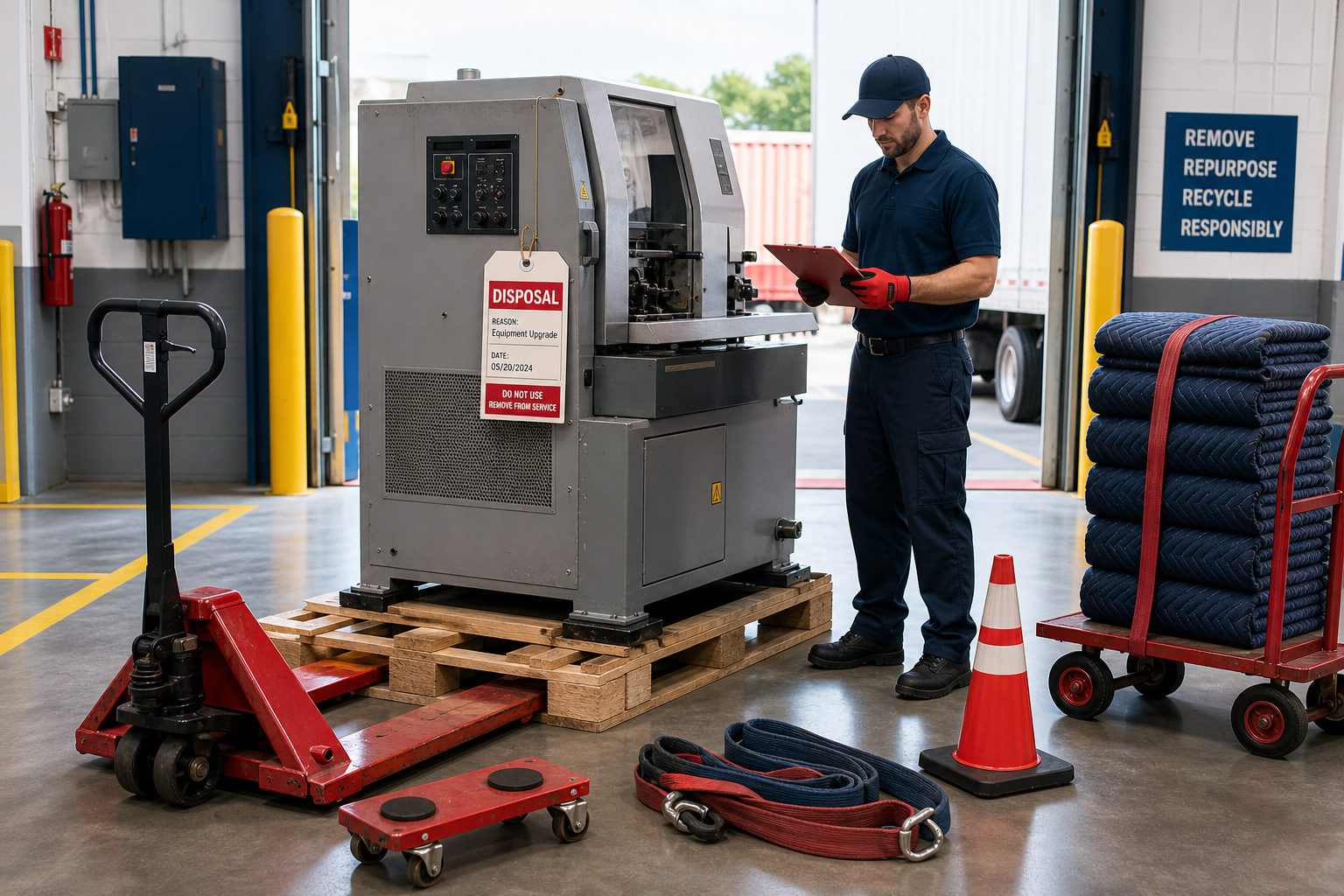
Equipment disposal is safest and most efficient when planning starts before anything is lifted, rolled, disconnected, or loaded. Businesses need to identify what is leaving, confirm how each asset should be handled, and address utilities, stored energy, data, and regulated materials before transport.
Create an Equipment Disposal Inventory Before Anything Is Removed
A strong disposal plan starts with a written inventory. Before a removal crew arrives, designate a project lead who can make decisions, answer questions, and approve changes. That person should coordinate with facilities, IT, safety, finance, and any department that owns or uses the equipment.
The inventory should be specific enough to guide safety planning and final disposition. Include the equipment name, manufacturer, model, serial number, dimensions, approximate weight, current location, condition, ownership status, and intended pathway. This helps identify assets that may require disassembly, special handling, data sanitization, hazardous-material management, resale preparation, or disposal documentation, especially during records management planning.
Classification is the next step. Equipment may be operational and reusable, repairable, suitable for parts, recyclable, hazardous, or waste. Choosing too quickly can create compliance gaps or missed value.
Before labeling equipment for removal, confirm leases, liens, warranties, ownership, and any manufacturer take-back obligations. Keep an approval record showing who authorized the decision, especially when equipment contains confidential information, regulated substances, or valuable components.
A practical asset record should support both handling and final disposition
A useful equipment disposal inventory should help the removal team understand what is moving while helping the business document what happened afterward. For each item, record photographs, condition notes, disposition approval, handler, destination, removal date, and final outcome. For electronics, add media identifiers and sanitization records where applicable.
De-Energize Equipment and Control Hazardous Energy Before Transport
Equipment should not be treated as ready for removal simply because it is no longer in use. Machinery and systems may still contain electrical, hydraulic, pneumatic, thermal, chemical, gravity, or mechanical energy. Stored or residual energy can remain in capacitors, pressurized lines, springs, flywheels, rotating parts, counterweights, and hot components.
The business should arrange for qualified maintenance personnel, electricians, equipment technicians, or vendors to shut down and disconnect assets before movers handle them. OSHA describes hazardous-energy control as a process that includes preparing for shutdown, isolating energy sources, applying lockout or tagout devices, releasing or restraining stored energy, and verifying that equipment is de-energized through hazardous-energy control steps.
Lockout/tagout is an employer-controlled safety procedure and should not be casually delegated to a moving crew. The employer’s authorized employees should identify isolation points, apply locks or tags under the facility’s energy-control program, and verify that the machine cannot start or move unexpectedly.
Before removal, disconnect electrical, water, gas, compressed-air, exhaust, data, and process connections. Secure doors, drawers, covers, guards, loose tooling, rotating assemblies, counterweights, and other movable parts. If an asset cannot be fully disconnected, document what remains connected and identify the specialist needed, such as a manufacturer, utility contractor, licensed electrician, refrigeration technician, or equipment vendor.
This is also where coordination with a commercial moving partner matters. When RCS is preparing for commercial moving work, advance information about utility status, equipment dimensions, weights, and handling restrictions helps the crew plan the removal route, support downtime planning, and avoid delays.
Separate Batteries, Oils, Refrigerants, Electronics, and Data Before Pickup
Many disposal problems come from treating mixed materials as ordinary equipment. Batteries, oils, fuels, coolants, refrigerants, solvents, chemicals, lamps, mercury-containing components, aerosols, and fire extinguishers may require separate handling. A dedicated materials list helps keep these items out of a general moving load.
EPA identifies batteries, pesticides, mercury-containing equipment, lamps, and aerosol cans as federal universal-waste categories, which require practices that prevent releases, along with labeling and release-response procedures for federal universal-waste categories. Businesses should determine the proper pathway before equipment reaches the dock.
Regulated materials should be removed or contained through the right procedure
Batteries should generally be removed when safe and appropriate, sorted by type, protected against short circuits and leaks, labeled, and routed to a qualified recycling or reclamation program. Some battery types may be subject to hazardous-waste or lead-acid battery requirements, depending on the material and applicable rules.
Oils, fuels, hydraulic fluids, and other liquids should be drained or removed only through procedures appropriate to the equipment and material. Used oil has specific management standards that encourage recycling, while hazardous-waste status can depend on contamination and applicable state rules.
Refrigerants should be recovered by a qualified technician before transport or disposal. A disconnected chiller, air conditioner, freezer, or laboratory unit should not be assumed ready for ordinary hauling. The facility or vendor should identify the refrigerant type and provide recovery documentation when required.
Electronics need both physical disposition and data protection
Computers, servers, copiers, printers, phones, scanners, networking devices, laboratory instruments, and storage systems require a separate information-security plan. Before these assets leave the premises, identify internal and removable media, including hard drives, solid-state drives, tapes, memory cards, USB devices, and embedded storage. For broader planning, review what businesses should know about business electronics recycling.
NIST recommends completing a certificate of media disposition for each electronic medium after sanitization in its Guidelines for Media Sanitization. Depending on policy and information sensitivity, the method may involve verified wiping, cryptographic erase, degaussing where applicable, or physical destruction.
Do not rely on deleting files, emptying a recycle bin, or performing a factory reset unless the organization’s approved process confirms it meets the required security level. For resale, donation, recycling, or destruction, retain records that connect the device, media, sanitization method, transfer date, and final recipient or handler.
Choose the Right Disposal Pathway and Document the Chain of Custody
Once equipment is safe to move and materials have been separated, the business still needs to choose the correct final pathway. The right option depends on asset condition, material composition, regulatory requirements, financial value, and the business objective. Some organizations want resale recovery, while others want donation, recycling, landfill diversion, or fast renovation clearance.
Landfill disposal should be a final option, not a default. It may be unsuitable or prohibited for batteries, oils, refrigerants, lamps, mercury-containing equipment, electronics, or other regulated materials. EPA guidance for small businesses emphasizes that generators must understand their waste category and remain responsible throughout the material’s life cycle in hazardous-waste management guidance.
Before making the final decision, compare practical pathways. Each option requires different preparation, documentation, and vendor controls. The best choice matches the asset’s condition, risk profile, and approved business objective.
Liquidation or resale: Best for working equipment with identifiable value, current specifications, service history, available parts, or useful accessories. Prepare photographs, serial numbers, manuals, maintenance records, and condition notes.
Donation or reuse: Appropriate for working equipment with limited resale value but continued practical use. Confirm recipient requirements in advance and document the transfer date, condition, and recipient.
Recycling: Useful for obsolete electronics, scrap metal, cables, appliances, and equipment with recoverable materials. EPA notes that electronics recycling can recover materials such as gold, copper, glass, and aluminum through electronics donation and recycling.
Disposal: A last option when reuse, resale, donation, or recycling is not appropriate. Confirm federal, state, and local requirements first, especially for regulated materials.
Chain-of-custody records should connect each inventory number to its serial number, photographs, approved pathway, handler, destination, date, and final outcome. For regulated materials, retain manifests, bills of lading, waste profiles, recycling receipts, certificates of recycling or destruction, refrigerant-recovery records, battery records, and vendor permits or certifications when applicable.
At pickup, use a signed release or custody transfer document listing the assets and materials removed. Record the carrier, vehicle or shipment reference, receiving facility, seal number where used, and exceptions such as missing accessories, visible damage, leakage, or rejected items.
Coordinate Site Access, Rigging Needs, and the Removal Schedule
Even a well-documented asset can cause problems if the removal route is not planned. Provide the moving company with an advance site brief showing equipment locations, dimensions, weights, center of gravity where known, disassembly points, utility status, and photographs of tight turns, stairs, ramps, doorways, elevators, and docks. Similar route-control details are important during a high-value equipment lab move.
Route planning should verify elevator dimensions, dock clearances, floor-load limits, turning radii, and alternate openings. Heavy or irregular assets such as generators, switchgear, chillers, safes, presses, medical devices, and laboratory equipment may require machinery skates, forklifts, gantries, cranes, specialized rigging, crating, climate-controlled handling, or technical disassembly. Healthcare teams can also review planning considerations for medical equipment moving.
Reserve freight elevators, loading docks, curb space, parking areas, and security access before removal day. Confirm dock height, truck restrictions, delivery windows, elevator capacity, door-protection requirements, floor protection, fire-lane rules, and any certificate-of-insurance or property-management requirements. The schedule should account for tenant activity, office moves, construction milestones, shutdowns, renovation access windows, and any temporary holding needs through commercial warehousing.
Before the crew arrives, clear aisles and work areas, remove loose items, identify equipment that will remain, mark approved removal items, and protect nearby walls and floors. Confirm who will release equipment, verify isolation, handle hazardous materials, approve substitutions, and sign the final inventory and chain-of-custody documents.
If your business is planning equipment removal as part of a relocation, renovation, warehouse cleanout, or facility change, RCS can help coordinate the moving and logistics side of the work, including related sustainable office decommission planning. Get a Quote through our contact page, or call us today at (804) 358-4035.