.svg)


.svg)
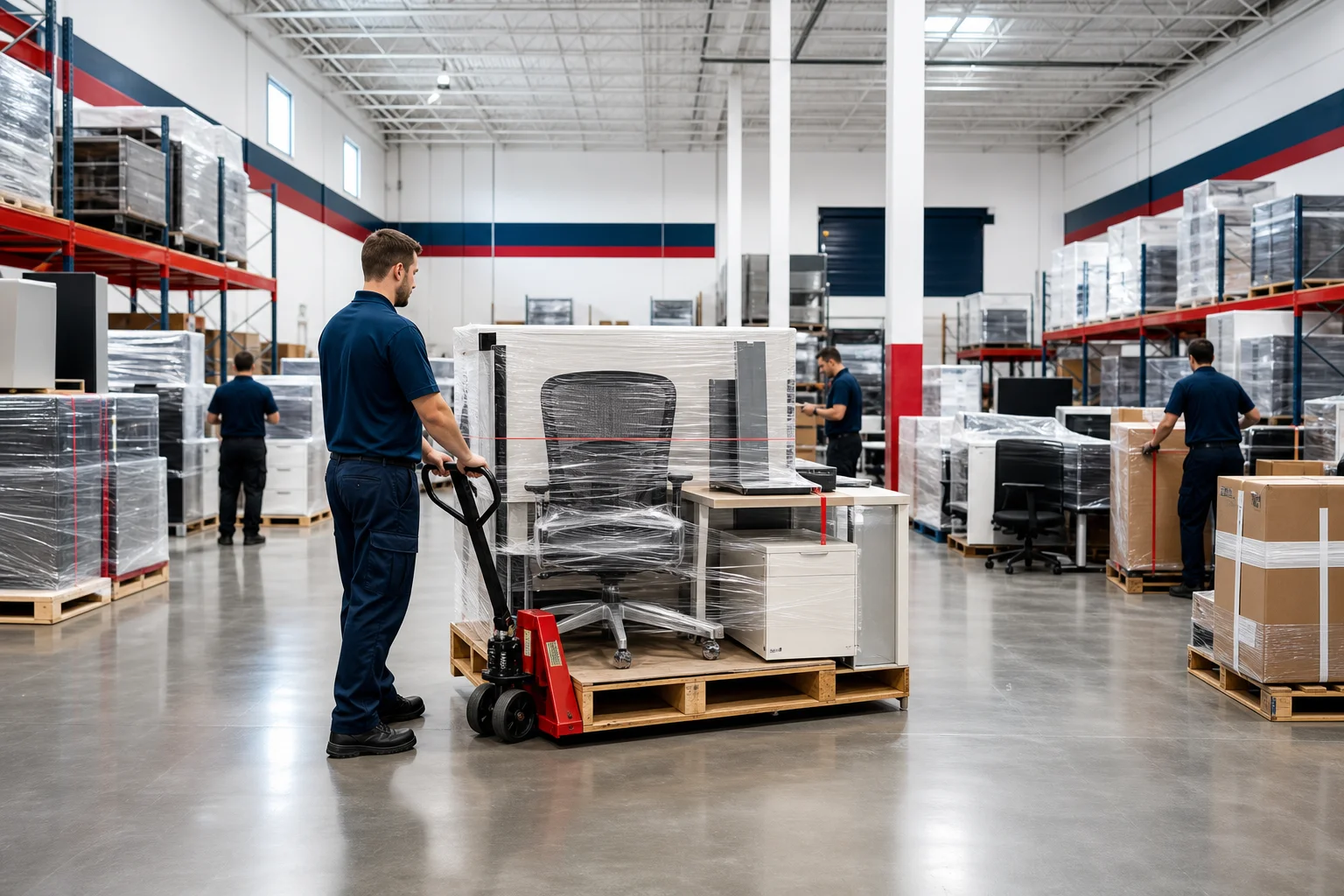
Commercial warehousing is most valuable when it does more than hold business assets. For office moves, renovations, tenant improvements, phased relocations, and furniture installations, storage often needs to function like an active project hub. Shipments must be received, checked, logged, staged, and delivered in the right order, not simply placed in a unit until someone asks for them.
RCS Commercial Moving & Warehousing supports companies across Virginia and North Carolina with commercial moving, storage, logistics, cross-docking, and installation services from locations serving Richmond, Lorton, Durham, Charlotte, and surrounding regional markets. If you have questions while comparing options, reach out to our team.
Commercial Warehousing Should Function as a Project Staging Environment
Businesses often start looking for commercial warehousing when their project schedule becomes more complicated than their office space can handle. Furniture may arrive before construction is complete. IT equipment may need to be held until power and cabling are ready. A phased move may require one department’s assets to be delivered while another department’s furniture remains in storage.
In these situations, warehousing is not passive storage. It becomes project warehousing, where furniture, fixtures, and equipment are managed from the moment they arrive. The warehouse may receive casegoods, seating, workstations, fixtures, and equipment, then organize those assets by project, floor, department, or installation phase.
That distinction matters. A consumer-style storage unit may provide space, but it typically does not provide the workflows businesses need for office projects. Commercial warehousing for FF&E projects includes receiving, inspection, inventory control, staging, delivery coordination, and often installation support. In large projects, the warehouse can become the primary staging environment for the full installation.
Short-term commercial storage may be needed for a few days or several months, depending on construction schedules, inspections, landlord requirements, and occupancy plans. Flexibility is important because deliveries often arrive in waves. A company may need more space during peak inbound shipments, then less space once furniture and equipment begin moving to the job site.
Receiving and Inspection Protect Furniture, Equipment, and Schedules
Receiving is one of the most important commercial warehousing services for office moves and installations. When multiple vendors are shipping to one project, someone needs to accept deliveries, unload trucks, verify counts, and create a usable record. Without that process, project managers may not know whether key items are ready until installers are already on site.
A professional receiving workflow usually records the purchase order, vendor, item counts, and visible condition of each shipment. The warehouse becomes the central receiving point for workstations, seating, casegoods, AV equipment, fixtures, and boxed business assets. This is helpful when project managers and facilities teams cannot be present for every delivery.
Inspection is equally important. Commercial furniture and equipment should be checked for carton damage, shortages, overages, and visible discrepancies. For furniture projects, that may include confirming that finishes, fabrics, components, panels, work surfaces, pedestals, and hardware match the approved specification. Issues can then be reported quickly so replacements or corrections can be addressed before installation.
Businesses comparing providers should ask how receiving and inspection are documented. The receiving log becomes the project’s working record. A provider that can document exceptions with clear notes and timely communication gives the project team a better chance of resolving issues before they affect occupancy.
Before selecting a warehouse partner, companies should understand what happens when a shipment arrives. A good process is structured, repeatable, and visible to the people managing the move or renovation. These are the practical capabilities to look for:
Acceptance of deliveries on the client’s behalf, so the client does not need to be present for every inbound truck.
Shipment logging by purchase order, vendor, count, item type, and condition.
Visual inspection for damage, shortages, overages, or mismatched specifications.
Prompt exception reporting when replacements, reorders, or vendor follow-up are needed.
Project-specific records that help reconcile warehouse receipts against purchase orders.
Receiving errors can become installation delays
Receiving and inspection may seem administrative, but they directly affect field work. Installers cannot complete a workstation if hardware is missing. A delayed chair shipment can affect occupancy readiness. Early documentation gives the project team time to react before the scheduled delivery or installation date.
Inventory Handling and Staging Should Match the Office Move Plan
Commercial warehousing needs strong inventory handling because office projects rarely move in one simple step. Assets may need to be sorted by floor, department, building, room, or phase. In a phased relocation, one team’s workstations may be delivered this week, while another team’s equipment remains in storage until construction or IT work is ready.
Modern commercial warehouse operations often track items at the pallet, carton, or item level. The research emphasizes SKU-level tracking, location codes, and status updates such as received, inspected, staged, loaded, and delivered. For project warehousing, dedicated project zones help keep each client’s assets segregated and accessible.
The purpose of staging is not just neatness. It is to prepare the right items for the right destination at the right time. When a warehouse can stage by phase, floor, department, and delivery window, the project team gains more control over labor, truck scheduling, elevator access, and installation sequencing. Staging is also where inventory handling turns into field efficiency. Rather than sending a mixed load to a job site, the warehouse can sequence items by destination and installation order. Products may be grouped for a specific building, floor, department, or workstation line. That reduces sorting in loading docks, hallways, elevators, and occupied office areas. Kitting can also support faster installation. Panels, work surfaces, pedestals, and hardware may be grouped for a specific workstation sequence. Chairs can be staged separately from panel systems. File cabinets can be scheduled after flooring is complete but before staff occupancy. These details help align warehouse activity with construction milestones and site readiness.
Security, Facility Condition, and Access Controls Matter for Business Assets
Commercial warehousing often involves valuable FF&E, business records, branded assets, electronics, and other materials that should not be treated like casual overflow. Companies comparing providers should look closely at how the facility controls access, protects inventory, and maintains suitable conditions for finished office furniture and equipment. Security expectations commonly include video surveillance, controlled access points, staff-only entry, access logs, alarms, and fire suppression systems. Professional commercial warehouses with restricted public access are generally preferred over self-storage settings where the general public can enter the property. For secure inventory or records, businesses may also need locked cages, limited-access rooms, documented chain-of-custody procedures, or periodic audits.
The condition of the warehouse matters as well. Finished office furniture can be affected by poor storage conditions. Businesses should evaluate whether the facility is clean, dry, well-maintained, and appropriate for wood, fabric, electronics, and other office assets. Some sensitive items may require temperature-controlled or secure storage zones separate from general inventory.
Security is not only about locks and cameras. It is also about accountability. A strong provider should know who accessed inventory, when items moved, and how assets were handled. That level of control is especially important for companies storing HR files, proprietary equipment, records, high-value electronics, or branded materials.
When evaluating a facility, it helps to separate basic storage from business-grade protection. A low-cost space may not offer the visibility, controls, or documentation a corporate project requires. Companies should confirm these points before committing inventory to a provider:
Controlled access to warehouse areas where business assets are stored.
Documented procedures for receiving, moving, pulling, and releasing inventory.
Secure options for records, electronics, confidential materials, or high-value goods.
Clean and well-maintained storage conditions suitable for finished office furniture.
Insurance, safety practices, and risk controls that align with business expectations.
Location and Cross-Docking Can Reduce Time Between Storage and Delivery
Location is a major factor in commercial warehousing because every mile between the warehouse and the project site adds transportation time and cost. For office moves and installations, proximity to job sites may matter more than the lowest storage rate. A warehouse near offices, construction sites, business districts, office parks, and regional road networks can support faster delivery and more flexible scheduling.
For companies operating across Virginia and North Carolina, access to major corridors such as I-95, I-64, I-85, and I-77 can support inbound freight and outbound deliveries to multiple offices or branches. During peak installation periods, crews may need to run several truckloads between the warehouse and job site in a single day. A convenient location can make those repeated trips more practical. Cross-docking adds another layer of speed. Instead of holding inventory for a long period, the warehouse unloads inbound shipments and transfers them quickly to outbound trucks. This is useful for time-sensitive commercial deliveries, regional distribution, distressed freight, overflow freight, and changing project schedules.
Cross-dock operations are designed for flow. The research notes that effective facilities may use one dock door per 2,500, 3,000 square feet, along with ample staging space and clear movement between inbound and outbound areas. These design features affect how quickly goods can be received, sorted, and dispatched.
For multi-location projects, cross-docking can help consolidate inbound freight from manufacturers, then sort shipments by destination city, office, store, or installation phase. A provider might receive bulk workstations for several markets, then route the right items to Richmond, Raleigh, Charlotte, or smaller locations based on schedule and site readiness.
How Businesses Should Compare Commercial Warehousing Providers
Choosing a commercial warehousing provider should be a structured decision. Cost matters, but it should not be the only factor. Businesses also need to evaluate location, handling capabilities, facility condition, security, scalability, service governance, reporting, and how well the provider supports the project’s schedule.
Service governance is often where stronger providers stand apart. Buyers may expect service level agreements that define turnaround times for receiving, inspection, put-away, staging, and outbound shipping. They may also ask about inventory accuracy, order accuracy, on-time shipments, damage rates, and customer service responsiveness. Clear communication is critical when the schedule is changing.
Technology and reporting also matter. Commercial warehousing may involve warehouse management systems, location codes, status updates, online portals, or other reporting tools that give clients visibility into inventory. According to guidance on choosing a warehousing partner, businesses commonly evaluate providers across location, capabilities, security, scalability, and pricing.
Pricing should be transparent. Companies should compare base storage rates, handling charges, access fees, delivery costs, and value-added service pricing. Itemized invoices help reduce confusion, especially when the project includes receiving, inspection, staging, storage, cross-docking, delivery, and installation coordination.
Contract flexibility is another practical issue. Renovations and tenant improvements can shift because of permitting, inspections, construction progress, or change orders. Businesses often prefer month-to-month or project-based terms over long fixed commitments, particularly when storage needs may expand during inbound deliveries and shrink as installation progresses. Guidance on storage partners also highlights the importance of proximity to offices and job sites when weighing provider options.
Commercial Warehousing Across Virginia and North Carolina
Square footage alone does not solve a commercial warehousing problem. The right provider has the space, staff, process discipline, receiving capability, staging area, delivery coordination, and communication rhythm to support the work. That is what turns storage into an asset for the move, renovation, or installation.
RCS provides commercial warehousing, receiving, cross-docking, delivery, and installation support through locations serving businesses across Virginia and North Carolina. We currently have significant warehouse capacity available at our Lorton, Virginia, facility, conveniently located for companies throughout Northern Virginia and the Washington, D.C. metropolitan area. Storage availability may also be available in other RCS markets based on your project’s location, inventory, and timeline. Request a Quote or call us today at (804) 358-4035.