.svg)


.svg)
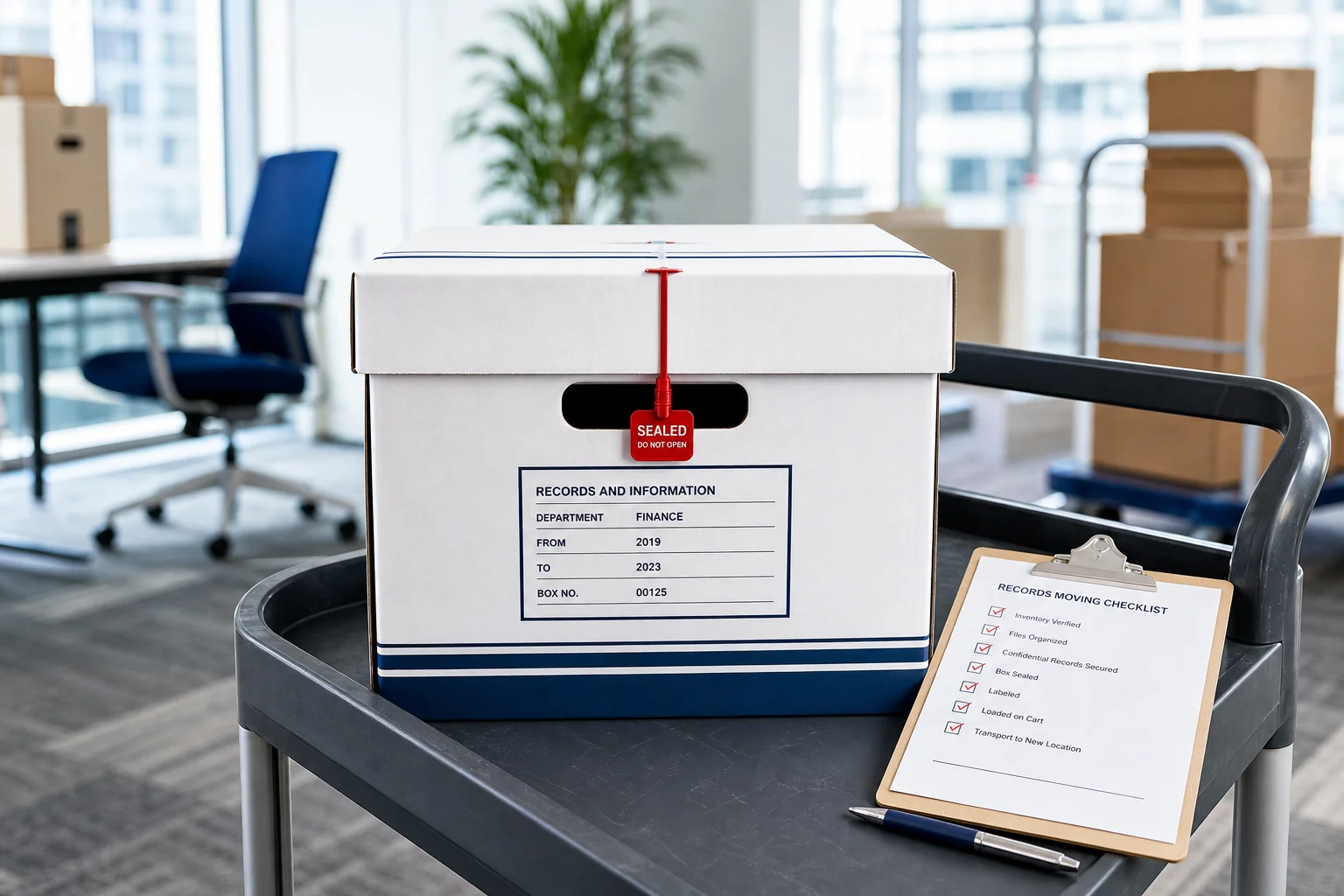
A workplace move, renovation, consolidation, or location closure can expose weaknesses in how physical files are stored, labeled, accessed, and protected. Desks, furniture, and equipment may be easy to see on a move plan, but paper records, archive boxes, microfilm, photographs, tapes, disks, and other media-based information need their own process.
Records management in this setting means treating physical business records as regulated assets, not general office contents. The goal is to keep files complete, retrievable, secure, and aligned with retention rules before, during, and after the transition.
Why Records Management Matters During a Commercial Move
Business records often require more planning than furniture or equipment. A misplaced file can delay operations, while documents containing employee, financial, legal, or client information may require additional handling precautions.
During a workplace transition, records management involves identifying physical files, determining which documents need special attention, and establishing where each group of records should go. Planning ahead helps organizations keep important information accessible and avoid moving unnecessary materials. This process also requires teams to distinguish between records, nonrecords, and personal materials. Records are the materials that must remain controlled through a lifecycle. Nonrecords may include duplicates, reference copies, convenience files, or outdated materials that should not be moved as if they were official files.
The U.S. National Archives recommends identifying which records remain in active use, which should be stored, and which may require other arrangements before an office move.
Physical Records Need a Separate Relocation Plan Because They Carry Access, Retention, and Security Risks
A typical office move plan focuses on space, furniture, equipment, staff seating, IT, and timing. Records require all of those considerations plus additional controls. A misplaced file box can create operational disruption. A confidential file exposed to unauthorized personnel can create a security problem. A record destroyed too early or retained too long can conflict with internal retention procedures.
Records also move on a different timeline than furniture. Teams may need to review retention schedules, identify destruction candidates, arrange digitization, coordinate secure shredding, or transfer inactive files into warehouse storage before moving day. These decisions can take longer than standard packing.
A separate records relocation plan helps answer practical questions before crews arrive. The most important point is simple: every file group should have a defined destination and handling method before it is packed. That reduces confusion, excess storage, and last-minute decisions during move week.
Business Records Management Should Separate Files by Use, Sensitivity, and Retention Status
Before packing begins, teams should classify records in ways that support both daily operations and compliance. The categories do not need to be complicated, but they do need to be clear enough for department owners, move coordinators, records staff, and relocation crews to follow. This classification also helps prevent active records from being buried in storage and inactive records from taking over valuable new office space. It creates a shared map for how records should move, where they should go, and who should be allowed to handle them.
Most organizations should identify at least these groups:
Active records: Files that teams use regularly and need available during or immediately after the transition.
Semi-active records: Files that must remain accessible but do not need to sit at individual workstations.
Inactive records not eligible for destruction: Records that must be retained but can usually be placed in managed storage.
Inactive records eligible for destruction: Files that have met retention requirements and can be destroyed under approved procedures.
Confidential or sensitive records: Records requiring restricted handling, secure containers, limited access, and documented custody.
Retention-controlled records: Records tied to specific schedules, disposition rules, transfer requirements, or legal obligations.
A Pre-Move Inventory Determines What Should Be Moved, Stored, Digitized, or Destroyed
The strongest records management plans begin with an inventory. This should happen before general packing, because the inventory drives every later decision. It helps teams avoid moving outdated materials, overfilling the destination, or losing track of files in transit.
Public relocation guidance consistently recommends documenting the type of record, current location, retention period, disposition, and any special concerns. The University of Wisconsin’s guide to managing records during an office relocation recommends capturing the record type, location, applicable schedule, retention period, disposition, and confidential or sensitive circumstances.
A useful inventory can be built at the box, file, or records series level, depending on the size of the archive and the risk level of the materials. A large healthcare, legal, university, or government archive may require more detail than a small administrative file room, but the same principle applies. The inventory must be accurate enough to support decisions and retrieval.
Every Storage Location Should Be Checked Before Packing Starts
Records are rarely located in one neat file room. They may be in filing cabinets, archive boxes, basements, closets, cupboards, departmental storage areas, off-site storage, or employee work areas. A walk-through should include every location where paper files or business media may be stored.
The inventory should also identify the owning department. That matters because records decisions should not be made only by the moving team. Department owners, records managers, legal or compliance contacts, and operations leaders may all need to sign off on what stays, moves, stores, digitizes, or destroys.
Retention Review Prevents Unnecessary Moving and Uncontrolled Disposal
Once the inventory is complete, records should be reviewed against retention schedules and organizational policies. Some files may need to remain in paper form. Others may be past their retention period and eligible for secure destruction. Some may need to be transferred to archives or records storage.
Business archiving guidance recommends starting the records audit well before the move and completing keep, shred, or digitize decisions before move week. A guide on business archiving before an office move advises applying keep, shred, and digitize decisions to every records category 6 to 8 weeks before the move.
This step can reduce the number of boxes moved, free up space at the destination, and help ensure records are handled according to policy. It also prevents the opposite problem: destroying files without proper review, documentation, or confirmation that no hold or active need applies.
Move, Store, Digitize, or Securely Destroy Each Record Group Based on Use and Retention Rules
After inventory and classification, each record group needs a destination decision. This decision should be made before packing labels are printed and before boxes are staged. The move plan should clearly state whether files are going to the new office, temporary storage, long-term warehouse storage, digitization, archives, or destruction.
Active records typically need to stay close to the teams that use them. These may move directly to the new office, to a nearby file room, or to a secure staging area that is accessible on day one. Their placement should be coordinated with the destination floor plan.
Inactive records that must be retained but are rarely accessed may not belong in the new office at all. If destination space is limited, these records can be routed into warehouse storage with retrieval procedures in place. This keeps office space available for current operations while preserving required records. Records identified for digitization should be handled on a schedule that avoids access gaps. If files are converted before the move, they should be uploaded, tagged, and access-tested before staff arrive in the new location. If original paper must still be retained, the physical files need their own storage and retention plan.
Records eligible for destruction should be handled by qualified providers that can perform secure destruction and provide documentation. This is especially important for confidential paper, drives, tapes, or other media. The mover’s role is not to replace shredding, IT asset disposal, or compliance vendors, but to coordinate the physical workflow around them when those services fall outside the relocation scope.
Labeling and Tracking Systems Keep Records Organized Without Exposing Sensitive Information
Labeling is one of the most practical records management controls during a move. It tells teams what a container is, where it came from, where it is going, and how it should be handled. For confidential records, however, labels must provide enough tracking detail without revealing sensitive content to unauthorized observers.
A strong system starts with consistent identifiers. Each box, crate, or sealed container should connect back to the inventory. The identifier may be a barcode, box number, container ID, department code, records series, or other internal tracking method. The important point is that every container can be matched to an approved list.
Chain-of-custody guidance from GRM Document Management describes an effective program as one that tags each record or container with a unique identifier, logs handoffs, controls access, documents final disposition, and audits the program regularly.
Labels Should Support Routing, Retrieval, and Disposition
A relocation label should do more than say “files.” It should help route the container correctly. A box of active HR files, an inactive archive carton, a destruction candidate, and a restricted legal record should not be handled as the same kind of move item.
Clear labeling reduces avoidable disruption after delivery. When staff need critical files on the first day in a new space, they should not have to search through mixed archive boxes. When inactive records are intended for storage, they should not be dropped into a crowded file room.
Before the move, teams should define label rules that identify:
The owning department or business unit.
The box or container number tied to the inventory.
The records category, such as active, inactive, restricted, storage, destruction, or immediate access.
The origin location, such as room, file area, floor, or department.
The destination location, such as workstation area, file room, secure holding room, warehouse storage, or destruction staging.
Any access or handling restrictions that crews and coordinators must follow.
Chain of Custody Protects Records During Packing, Transportation, Storage, and Delivery
Chain of custody is the documented control of records as they pass from one person, location, vehicle, or facility to another. During a workplace transition, it helps confirm that records were packed, transferred, transported, delivered, and received as expected. For sensitive records, chain of custody should begin before the first box leaves the file room. A designated records coordinator, security officer, department owner, or approved representative should confirm which containers are being released and to whom. The receiving party should then verify the same containers at delivery.
This process is especially important when records are moved into temporary storage, long-term warehouse storage, or staged holding areas. Each transfer point creates an opportunity for confusion unless there is a documented handoff.
Secure Containers and Access Limits Reduce Exposure During the Move
Confidential files should not be packed into ordinary boxes without additional controls. Secure containers, tamper-evident seals, locked rooms, and limited access all help protect records while they are outside their normal filing environment. Guidance on moving confidential documents and sensitive files recommends using lockable bins sealed with sequentially numbered, tamper-evident security seals, then documenting container IDs and seal numbers in a master spreadsheet.
Access should be limited to authorized personnel at the origin, during staging, in transport, at storage, and at the destination. When sealed containers arrive, receiving staff should verify container counts and seal integrity before files are released for use or placed into secure holding areas.
This is the point where a commercial relocation partner fits naturally into the records management plan. RCS Commercial Moving & Warehousing can support the physical side of the project through planning, packing coordination, secure handling, transportation, tracking, warehouse storage, and final placement, while the client’s records, legal, IT, and compliance teams define the governing policies.
Records Relocation Should Be Built Into the Broader Office-Move Schedule
Records work should not be treated as a last-week packing task. The relocation schedule should include records-specific milestones, department reviews, destruction deadlines, digitization timing, container delivery, secure staging, pickup windows, warehouse routing, and destination placement.
The earlier these milestones are built into the project plan, the less likely teams are to face rushed decisions. Records may need sign-off from people who are not involved in furniture or equipment planning. Secure destruction, archival transfer, or digitization may also require outside providers with their own timelines.
A practical sequence may begin with a records audit, followed by inventory, classification, retention review, disposition decisions, secure destruction scheduling, packing, container sealing, transportation, delivery verification, and destination placement. The exact timing depends on archive size and organizational requirements, but the work should start early enough to avoid move-week pressure.
Records Teams, IT, Compliance, and Movers Need Clear Role Boundaries
Business records management is a shared effort during a transition. Records and information managers may define retention and disposition requirements. Department leaders may identify active files. IT teams may handle equipment, electronic systems, or media issues. Compliance or legal teams may review sensitive or retention-controlled categories.
The moving and warehousing provider handles the physical logistics within the rules the organization sets. That includes packing coordination, container movement, transport, warehouse placement, inventory alignment, and destination delivery. Qualified shredding, IT asset disposal, digitization, or compliance providers should be involved when those functions fall outside the mover’s role.
Destination Placement Determines Whether Files Stay Accessible After the Move
The records plan is not finished when boxes leave the old location. Destination placement determines whether staff can resume work without searching through stacks of cartons. It also determines whether confidential files are secured, inactive files are routed correctly, and records remain retrievable after the transition. Destination planning should identify where each category of record will live. Active files may need to be placed near work areas or in centralized file rooms. Restricted records may need locked rooms or controlled access areas. Inactive records may go directly to warehouse storage instead of the new office.
The EPA’s Records Management Tool Kit advises planning the new space by determining placement for records and nonrecords, including workstations, centralized active files, centralized inactive files, and technical reference materials. This planning should be coordinated with floor plans, shelving, file cabinets, racking, access permissions, and staff workflows. If there is not enough room at the destination, records should be identified and sent to storage before move day rather than arriving at the new office with no place to go.
Temporary and Long-Term Warehouse Storage Helps Control Space and Retrieval
Warehouse storage can be useful when an organization must retain records but does not need daily access to them. It can also support phased relocations, renovations, consolidations, and closures where records must be held securely until a final destination is ready. The key is to avoid treating storage as a dumping ground. Stored records still need inventory, labels, access rules, retrieval procedures, and retention controls. Without those pieces, warehouse storage may solve a space issue but create an access problem later.
When warehouse storage is part of the plan, organizations should confirm:
Which records are approved for storage rather than office placement.
How each stored box or container connects to the records inventory.
Who is authorized to request retrieval.
How quickly stored records may need to be accessed.
Whether stored records have future destruction, archive transfer, or review dates.
How confidential or restricted materials will be segregated and controlled.
A Strong Records Management Plan Reduces Disruption During Moves, Renovations, Consolidations, and Closures
Records management protects more than files. It protects continuity. When records are inventoried, classified, labeled, tracked, and placed correctly, teams are better prepared to keep working through a transition. They know what is moving, what is stored, what is being digitized, and what is being destroyed under approved procedures. It also reduces the amount of unnecessary material that moves into a new facility. Files that have met retention requirements can be reviewed for secure destruction. Inactive archives can be routed to storage. Active files can be prioritized for immediate access. Confidential records can be handled with the controls they require.
For facility managers, office managers, operations leaders, records managers, healthcare administrators, legal administrators, government agencies, universities, and archive-heavy organizations, the best time to solve records issues is before the move begins. Once crews are on site and deadlines are tight, every unresolved records question becomes more disruptive.
The practical path is to start early, assign owners, inventory thoroughly, apply retention rules, separate active and inactive files, protect confidential materials, document chain of custody, and coordinate destination placement. A relocation is not just a change of address. It is an opportunity to bring physical records back under control.
Plan the Physical Side of Your Records Move With RCS Commercial Moving & Warehousing
If your organization is preparing for a commercial move, renovation, consolidation, or location closure, RCS Commercial Moving & Warehousing can help plan and manage the physical logistics of your records transition. Our team supports commercial moving, warehouse storage, secure handling coordination, transportation, tracking, and final placement for organizations with complex workplace needs.
Request a Quote through our contact page at https://www.rcsmoving.com/contact-us or call (804) 358-4035 to reach out to our team.