


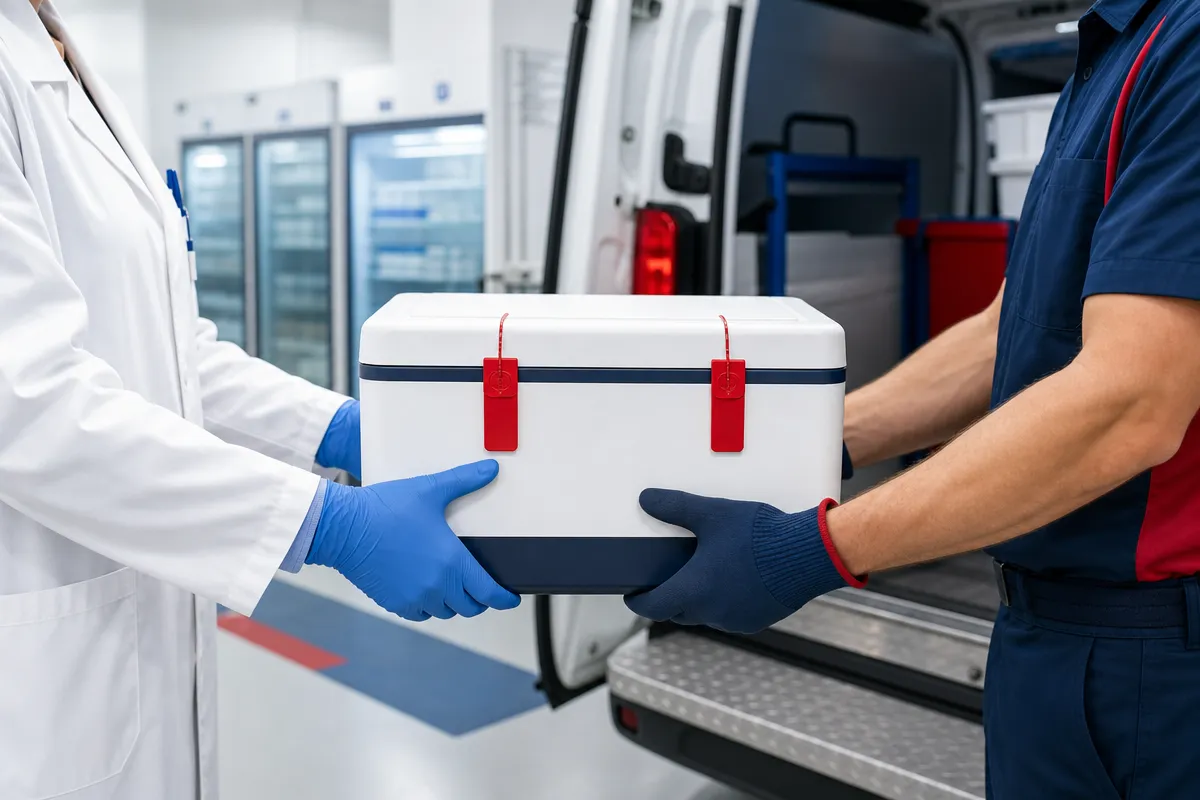
A mover is only one part of a successful lab relocation. When specimens, human-derived materials, infectious substances, toxins, temperature-sensitive reagents, or research samples are involved, the move depends on planning, scientific oversight, documentation, packaging responsibility, and disciplined handoffs.
Moving Biological Materials Starts With Clear Governance and Scope
A lab relocation involving biological materials should begin with a written project plan. That plan should separate ordinary laboratory equipment from research specimens, diagnostic samples, human-derived materials, infectious substances, toxins, genetically modified materials, select agents, animal materials, dry ice, liquid nitrogen, and temperature-sensitive reagents.
This distinction matters because classification affects packaging, labeling, documentation, vehicle selection, route planning, permits, personnel qualifications, emergency controls, and receiving procedures. Biological materials may be regulated under U.S. Department of Transportation requirements in 49 CFR Parts 171-180, so the project plan must identify who is responsible for regulatory decisions before packing begins.
The customer should appoint a project owner with authority over scientific decisions. A separate mover project manager should be responsible for execution. The laboratory’s principal investigator or specimen custodian should approve what moves, the required temperature range, acceptable transit duration, and the disposition of damaged or compromised material.
EHS or biosafety personnel should classify hazards, approve packaging and handling procedures, and verify permits. Facilities teams should control access, loading docks, elevators, power, security, and receiving-room readiness. These roles should be documented, not assumed.
A responsibility matrix prevents unsafe assumptions during specimen relocation
A responsibility matrix should identify one accountable party for every activity, including inventory creation, hazard classification, packaging, labeling, temperature conditioning, loading, vehicle preparation, route approval, custody signatures, data-log review, receiving inspection, freezer placement, deviation management, and final reconciliation.
The mover should not independently classify unknown samples or open, relabel, repackage, aliquot, or dispose of specimens unless the customer has authorized those actions under an approved procedure. For hazardous or potentially infectious material, the customer must ensure legally required trained personnel prepare the shipment.
Inventory and Risk Profiling Give Every Specimen a Defined Move Path
Before packing begins, the laboratory should create a controlled inventory that connects each container, rack, box, freezer, or shipment identifier to its source and destination. This inventory should support scientific, custody, receiving, and exception-management decisions.
NIH policy requires potentially hazardous biological materials to be inventoried before long-term storage in freezers, refrigerators, cold rooms, or other locations, reinforcing the need for disciplined records before relocation. An effective move inventory should not treat the entire laboratory as one shipment. Each material group should have its own risk profile.
A practical profile can score biological hazard, temperature sensitivity, fragility, irreplaceability, regulatory restriction, data sensitivity, spill consequence, and recovery difficulty. High-risk examples include infectious materials, select agents, irreplaceable clinical specimens, ultra-low-temperature samples, materials dependent on continuous power, and items whose identity or chain of custody is legally significant.
The inventory should divide materials into handling categories so laboratory staff, EHS, facilities, and the moving team do not have to infer whether a container can be handled by the mover.
Do not move: Materials excluded from the relocation plan, not cleared for transport, or awaiting scientific disposition.
Move only by laboratory staff: Materials requiring direct scientific handling, special internal controls, or staff-only access.
Mover may handle: Sealed, externally clean, correctly labeled packages accepted under the approved procedure.
Laboratory personnel should normally open freezers, select specimens, close primary containers, verify labels, and place samples into approved transport packaging. Movers can handle sealed and verified packages after acceptance, but should not infer contents from informal labels or move unverified containers.
Required records should include the approved inventory, risk assessment, packing instructions, packaging specifications, permits, shipping papers, training records, route plan, vehicle inspection, temperature-monitoring plan, custody log, exception reports, receiving checklist, and final reconciliation.
Packaging Responsibility and Temperature Control Must Be Defined Before Pickup
Packaging for biological materials should be selected from the material’s classification and temperature requirement, not ordinary office-moving supplies. For potentially infectious material transported within a facility, NIH describes a primary container inside a watertight, unbreakable secondary container, with enough absorbent material to contain the primary container’s liquid contents if it breaks.
For regulated shipments, the applicable tested or performance-certified packaging must be used with the correct marks, labels, orientation markings, emergency information, and shipping documents. Category A and Category B infectious substances have different requirements. Dry ice adds handling, ventilation, marking, and documentation considerations.
The shipper, not the moving crew, must confirm the classification and prepare the regulated package. Only properly trained personnel may package hazardous materials. NIH shipping procedures identify DOT and IATA requirements for biological materials and require trained personnel to package hazardous materials, including standards for classification, packaging, marking, labeling, and transport documentation.
Cold-chain instructions should be specific enough to guide acceptance decisions
Temperature-control instructions should state the target range, allowable minimum and maximum, excursion duration, conditioning method, coolant quantity, monitoring device location, and acceptance criteria. These details should be approved before pickup so the receiving team has objective criteria for accepting, quarantining, or escalating a package.
Cold-chain packages should include enough coolant for the planned journey plus a documented contingency margin. NIH shipping procedures advise preparing perishable shipments with sufficient dry ice to last several days if transit is delayed. For ultra-low-temperature samples, dry-ice or liquid-nitrogen systems should be validated for the intended use, and transport containers should be compatible with the relevant phase and pressure hazards.
Temperature monitors should be started and time-synchronized before pickup. Each monitor should be assigned to identified package or container IDs and protected from direct contact with coolant unless that is the intended measurement. At delivery, monitor data should be downloaded and reviewed as part of acceptance.
A monitor reading outside limits should trigger quarantine and scientific disposition, not automatic acceptance. The record should identify the affected package IDs, logger data, duration, highest and lowest readings, packaging condition, corrective actions, and final disposition.
Chain of Custody Depends on Controlled Handoffs From Release to Placement
Chain of custody should begin when laboratory staff release a sealed package. It should end only when an authorized receiving person verifies identity, condition, temperature, and placement. Every transfer record should include package ID, seal number, date and time, origin, destination, releasing person, receiving person, signatures or authenticated electronic confirmation, package condition, temperature status, and any discrepancy.
At pickup, laboratory staff should reconcile the package against the approved inventory. They should verify labels and seals, document the starting temperature and monitor ID, and sign release. The mover should inspect only the external condition unless authorized otherwise, record the vehicle or container assignment, and acknowledge custody of the sealed package.
This is where a qualified commercial relocation partner can support the process without taking over scientific decisions. RCS can coordinate move execution, staging, logistics, and documented handoffs while the customer’s PI, EHS, biosafety, facilities, and receiving teams retain the scientific and regulatory responsibilities assigned in the project plan.
Staging should be minimized because every extra handoff adds risk
At staging and transport, each movement into or out of a controlled area should be logged. The record should show the staging location, entry and exit times, responsible employee, security status, temperature reading or logger status, and any opening or coolant replenishment.
Staging should be minimized because each handoff creates an opportunity for misidentification, delay, unauthorized access, or temperature loss. If staging is necessary, it should be planned as a controlled step with assigned personnel, approved locations, and documented status checks.
At delivery, the receiving laboratory should inspect seals, package condition, labels, count, temperature data, and evidence of leakage or damage before signing. Samples with broken seals, missing identifiers, wet packaging, suspected leakage, or temperature excursions should be isolated in a predetermined quarantine location.
Escalation paths should already be defined. The receiving team should know when to contact the PI, EHS, biosafety officer, and quality representative. No one should decide in the receiving area, under time pressure, whether a compromised specimen can be accepted.
Routes, Vehicles, and Receiving Areas Should Be Ready Before Loading Begins
The route plan should be approved before loading. It should account for regulatory restrictions, jurisdictional permits, border or campus controls, road closures, weather, traffic, bridge limits, security requirements, and emergency services. Routes for regulated biological materials should be consistent with applicable DOT, state, local, institutional, and, where relevant, ICAO or IATA requirements.
Air transport requires the applicable dangerous-goods framework and trained preparation personnel. IATA training for infectious substances covers classification, labeling, documentation, handling, and emergency procedures, and its shipper courses are directed at personnel responsible for preparing dangerous goods.
Vehicle planning should match the material risk. Dedicated or appropriately segregated temperature-controlled capacity may be needed. The vehicle plan should specify validated temperature capability, backup power or coolant, cargo restraints, access control, spill supplies, fire extinguisher, communication equipment, GPS or dispatch visibility, and procedures for unauthorized stops.
Ordinary moving trucks should not be treated as validated cold-chain vehicles simply because they can carry insulated boxes. The question is whether the vehicle plan supports the approved temperature, custody, security, and contingency requirements for the specific materials being moved.
Receiving readiness reduces dwell time and protects temperature-sensitive materials
Before pickup, facilities and the receiving laboratory should confirm dock access, elevator reservations, security clearance, parking, escort requirements, freezer or cold-room capacity, electrical supply, alarm status, backup power, rack layout, and a direct path from unloading to storage.
Receiving areas should be clean, secure, access-controlled, appropriately ventilated, and pre-cooled or otherwise ready for the specified material. Freezer and cold-room capacity should be checked against the reconciled inventory, with spare capacity for rejected or quarantined packages.
Receiving personnel should know where each box or rack will be placed before the truck arrives. That preparation reduces dwell time and unnecessary handling. For dry ice and cryogenic materials, the facility’s EHS program should verify ventilation and oxygen-monitoring arrangements where required.
Contingency Planning and Team Coordination Protect the Move When Conditions Change
A biological material relocation plan should define actions for traffic delays, vehicle breakdown, refrigeration failure, dry-ice depletion, freezer failure, power loss, damaged packaging, missing packages, broken seals, spills, exposure, theft, weather disruption, and inability to reach the destination.
The plan should provide 24-hour contacts for dispatch, the mover’s operations manager, the PI or specimen custodian, EHS or biosafety, facilities, security, and the receiving laboratory. A delay plan should establish decision thresholds, such as maximum time outside controlled storage, minimum remaining coolant, or projected arrival beyond the validated hold time.
Possible responses may include rerouting to an approved cold-storage site, replenishing dry ice through an authorized supplier, transferring to a backup vehicle, returning to the origin freezer, or placing material into an approved receiving facility. Every intervention should preserve package identity and be recorded in the custody log.
For equipment failure, the mover should stop, secure the load, notify designated contacts, record location and temperatures, and avoid opening packages unless a trained and authorized person directs the action. If a spill or suspected exposure occurs, personnel should isolate the area, follow the customer’s biosafety and occupational-health procedures, contact emergency services when appropriate, and preserve incident evidence.
Vendor qualification should be part of this planning process. A qualified commercial mover should be able to demonstrate experience with laboratory, healthcare, biotech, or research relocations, documented SOPs for biological materials, secure chain-of-custody systems, temperature-controlled vehicles and monitoring, incident procedures, 24/7 dispatch, and adequate insurance. When applicable, ask for evidence of current training in infectious substances transport training and other relevant requirements.
Coordination should start early enough to address inventory freeze dates, sample triage, freezer defrost or shutdown plans, permits, packaging procurement, route approvals, receiving validation, and contingency capacity. The schedule should be built around experiments, clinical workflows, animal studies, assay deadlines, instrument downtime, freezer maintenance, regulatory milestones, and staff availability, not only the building move date.
If your organization is planning a lab relocation involving specimen moves, temperature-sensitive materials, or documented handoffs, RCS Commercial Moving & Warehousing can help coordinate the commercial move, logistics, storage, and installation work around your internal scientific and EHS controls. Request a quote through our contact page, call us today at (804) 358-4035, or email us at contact@rcsmoving.com.