


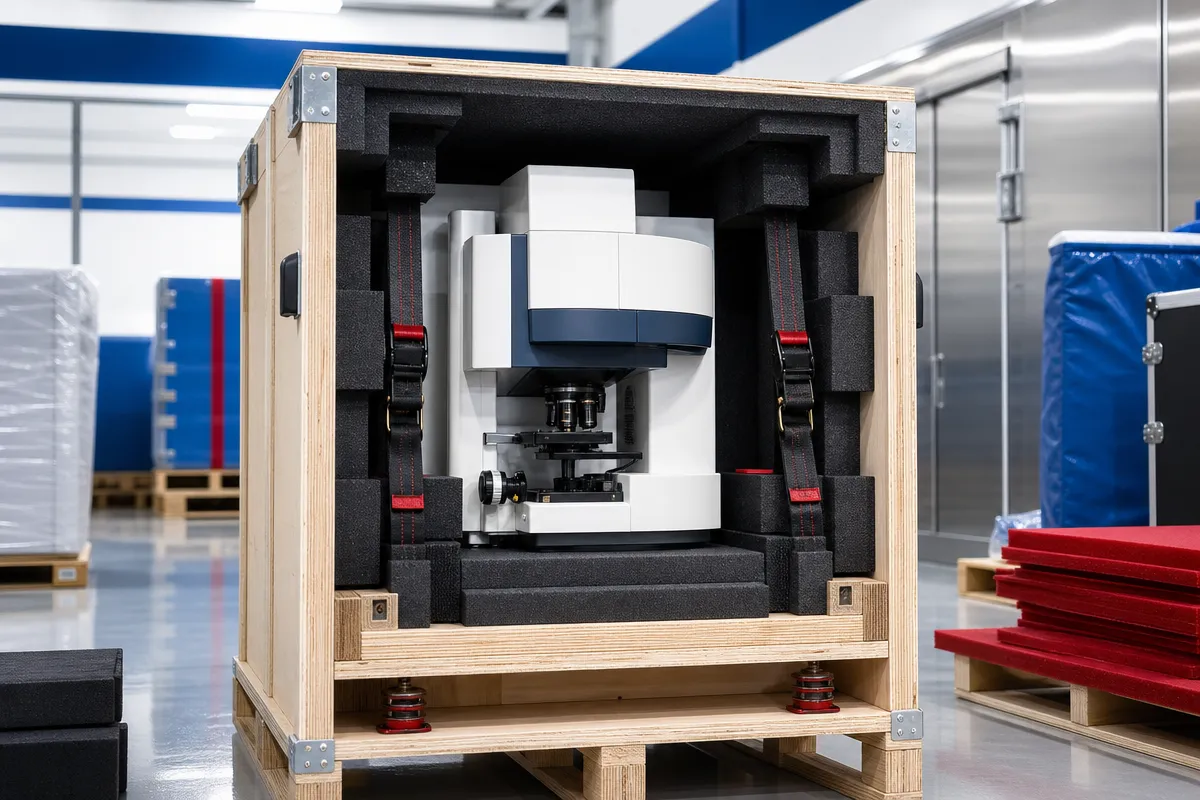
Lab equipment storage is not the same as putting office furniture, files, or general supplies into a warehouse. Sensitive research equipment may need defined temperature and humidity ranges, vibration controls, custom crating, strict chain of custody, planned access, and a clear path back to calibration and use.
Lab Equipment Storage Starts With Manufacturer Requirements, Not a Generic Warehouse Label
The safest storage plan begins with the original equipment manufacturer’s requirements for each instrument. A broad label such as climate-controlled storage is not specific enough for laboratory equipment. Requirements can vary by instrument and may include temperature range, humidity limits, vibration exposure, dust control, ventilation, power quality, altitude, and allowable storage orientation.
Temperature and humidity excursions can affect electronics, optics, seals, detectors, displays, batteries, and precision mechanical assemblies. Some refrigerated or frozen instruments may require dedicated controlled space. Other analytical systems may need stable ambient conditions and continuous environmental monitoring during the storage period.
Vibration deserves special attention because many scientific instruments are designed to operate in stable environments. Analytical balances, electron microscopes, NMR systems, centrifuges, optical instruments, and similar equipment can be affected by vibration during transportation, warehouse handling, or storage. A storage plan should identify these assets before the move, not after a performance issue appears.
A qualified provider should document the required range for each asset, define alarm thresholds, monitor conditions when warranted, and maintain a response plan for HVAC failure, power loss, flooding, fire, or delayed delivery. Guidance on laboratory asset relocation also emphasizes the importance of decommissioning, environmental controls, documentation, and qualification planning when moving sensitive laboratory assets.
The practical takeaway is simple: storage conditions should be matched to the equipment, not the other way around. If a warehouse cannot demonstrate that it can meet and document the required conditions, it may not be the right environment for sensitive laboratory equipment.
OEM Instructions and Pre-Storage Preparation Protect Equipment, Warranty Status, and Future Use
Before laboratory equipment enters storage, the project team should confirm how each instrument must be shut down, disconnected, moved, packed, stored, and recommissioned. OEM instructions should guide these steps because manufacturer-specific procedures may affect warranty coverage, service agreements, calibration status, and future technical support.
Pre-storage preparation should also establish a clear baseline. If the instrument later arrives with a missing accessory, changed condition, or performance concern, the team needs records that show what existed before storage began. That baseline protects the laboratory, the logistics provider, and the receiving facility.
A strong preparation process may include several asset-level records and physical steps before equipment leaves the lab:
Recording serial numbers, asset IDs, accessories, known defects, operating condition, and calibration status.
Taking photographs of the instrument, its components, and its condition before packing.
Documenting software configuration and connected accessories when applicable.
Draining HPLC systems, water baths, cooling circuits, or other equipment where fluids must be removed.
Purging gas lines and disconnecting utilities, networks, and related services.
Decontaminating equipment exposed to biological or chemical agents before it is accepted for storage.
Securing centrifuge rotors, robotic components, and other moving assemblies.
Responsibility for each step should be assigned in writing. Laboratory staff, the storage provider, OEM technicians, calibration providers, and the receiving site may all have different roles. Written responsibility matrices reduce gaps between shutdown, contents removal, decontamination, disconnection, crating, transport, storage, installation, calibration, validation, and return to service.
This planning is especially important when a renovation or relocation has multiple phases. A missed disconnection, undocumented accessory, or unclear decontamination status can delay pickup, storage acceptance, delivery, or recommissioning.
Crating and Physical Protection Should Be Designed Around Each Instrument
Crating for laboratory equipment should be based on more than size and weight. The packaging plan should account for center of gravity, fragile optics, protruding components, moving assemblies, electronics, contamination controls, lifting points, and the manufacturer’s handling instructions.
Vibration-sensitive instruments may require multi-layer vibration-dampening crates, foam isolation, shock indicators, and specialized handling. Heavy equipment may need reinforced skids or pallets rated for the actual load. Rigging methods should prevent tipping, impact, or stress on weak points.
Centrifuges show why equipment-specific handling matters. Laboratory transport guidance may call for removing the rotor, crating it separately in the manufacturer’s container or an equivalent protective case, then reinstalling and balancing it before use. Similar asset-specific procedures may apply to cryogenic systems, mass spectrometers, microscopes, lasers, and large analytical platforms.
A storage partner should be able to explain how each instrument will be protected during loading, warehouse movement, storage, and final delivery. In practice, that may involve custom crates, internal bracing, moisture protection where appropriate, tilt and shock indicators, air-ride vehicles, documented inspection points, and rules against stacking or repositioning equipment without authorization.
RCS Commercial Moving & Warehousing provides commercial moving, warehouse storage, installation services, and logistics support, so these protection decisions can be planned alongside transport, staging, and delivery instead of treated as separate afterthoughts.
Physical protection should also extend to short-term holding points. Equipment temporarily staged in a loading area, swing space, transition warehouse, or jobsite should remain labeled, protected from unauthorized access, and tracked under the same controls as equipment in longer-term storage.
Inventory, Chain of Custody, and Security Keep Scientific Equipment Traceable
Laboratory equipment storage should include a detailed inventory that identifies every instrument, component, accessory, rack, container, freezer box, and related item. Unique labels, barcodes, or equivalent tracking methods help ensure that equipment can be located, released, delivered, and reconciled accurately.
Inventory records should include serial numbers, asset IDs, ownership, location mapping, condition, destination, storage requirements, and responsible parties. The goal is not just to know that something is in storage. The goal is to know exactly what it is, where it is, what condition it was in, what requirements apply, and who is responsible for it at each stage.
Chain of custody should continue from pre-move planning through pickup, transport, warehouse receipt, storage access, delivery, installation, and final verification. Each handoff should record who released the asset, who accepted it, when the transfer occurred, where the asset was located, and whether the condition matched the prior record.
For regulated or high-value assets, security controls should be stronger than ordinary commercial storage. The plan should evaluate restricted-access storage areas, employee authorization, visitor controls, surveillance, alarm systems, fire protection, incident reporting, insurance, cybersecurity for connected inventory platforms, and procedures for lost, damaged, or tampered equipment. Providers that handle scientific assets often describe these controls as part of distribution and fulfillment processes for specialized equipment and materials.
A useful inventory platform should support reconciliation at receipt and delivery, exception reporting, photographs, condition notes, and on-demand asset reports. For regulated work, the record may also need transport logs, temperature and vibration data, calibration documents, deviation assessments, and proof that the correct equipment and accessories were returned to the correct room.
Planned Access and Short-Term Staging Reduce Downtime During Renovations
Many laboratory storage projects happen during renovations, phased buildouts, or relocations where the lab still needs some level of operational continuity. Storage planning should reflect how the laboratory will function while equipment is moving in and out of service.
Critical equipment, work in progress, samples, consumables, and records should be sequenced with laboratory management and environmental-health-and-safety personnel before movement begins. This sequencing helps avoid a situation where essential equipment is inaccessible, delivered too early, or stored without the controls needed for later use.
A commercial storage partner should be able to support scheduled retrievals, partial releases, direct delivery from storage, and room-by-room staging. Treating the entire project as one warehouse shipment can create unnecessary disruption. Phased sequencing can help preserve testing capacity and reduce downtime while construction, commissioning, or receiving-site preparation continues.
The receiving site should be ready before equipment is released. That readiness may include verified floors, clearances, HVAC, utilities, electrical capacity, network connections, ventilation, gas supplies, and any required cleanroom or biosafety conditions. Delivering sensitive instruments before the space is ready increases handling cycles and exposes equipment to avoidable risk.
Short-term staging still requires formal controls. Equipment held temporarily at a jobsite, swing space, loading area, or transition warehouse should remain labeled, protected from unauthorized access, and tracked under the same chain-of-custody process as long-term stored assets. Lab relocation providers frequently describe laboratory relocation services as a planned sequence of move management, equipment handling, vendor coordination, and staged delivery, rather than a single pickup and drop-off.
This is where access planning becomes a risk-management tool. The storage provider, laboratory team, construction team, OEMs, and calibration specialists should know what can be released, when it can be released, where it should go, and what must happen before it returns to service.
Recommissioning Ends the Storage Project Only After Equipment Is Verified for Use
Storage is not complete when the crate reaches the new room. It ends when the equipment has been inspected, reconciled, installed, connected, calibrated if required, and approved for use. This final stage should be planned before equipment ever leaves the original lab.
After delivery, the provider and laboratory should inspect the crate and instrument, compare the asset to the inventory, document condition, install it in the approved location, reconnect utilities, and confirm that components and accessories are present. Any exceptions should be recorded and resolved through a defined process.
Relocation can affect alignment, leveling, detector response, calibration, and performance. Transport vibration, temperature changes, handling, and storage conditions may all matter. Reinstallation should follow OEM instructions, with OEM or qualified specialist involvement for sensitive platforms or equipment covered by service contracts. Resources on protecting scientific instruments also stress vibration, temperature, documentation, and qualification concerns when laboratory equipment is moved.
In regulated environments, recommissioning may include Installation Qualification, Operational Qualification, and Performance Qualification. IQ confirms correct installation and environmental conditions. OQ tests operation against written acceptance criteria. PQ confirms performance for the intended application using representative samples or reference standards.
Calibration should be performed against suitable certified standards, with updated certificates and documented results. Return-to-service criteria may include final position, utilities, software and network connectivity, vendor signoff, calibration status, resolved exceptions, and owner acceptance.
The final project file should preserve the pre-move baseline, storage and transport records, condition reports, environmental data, installation documentation, calibration certificates, qualification protocols and results, deviations, change controls, and approval to resume research or regulated testing. Guidance on compliance and chain of custody reinforces the importance of traceability from planning through final verification.
If your organization is planning laboratory equipment storage during a move, renovation, or phased buildout, RCS can help coordinate the commercial moving, warehouse storage, logistics, and installation support needed to protect sensitive assets. Request a Quote through our contact page, or call us today at (804) 358-4035.