


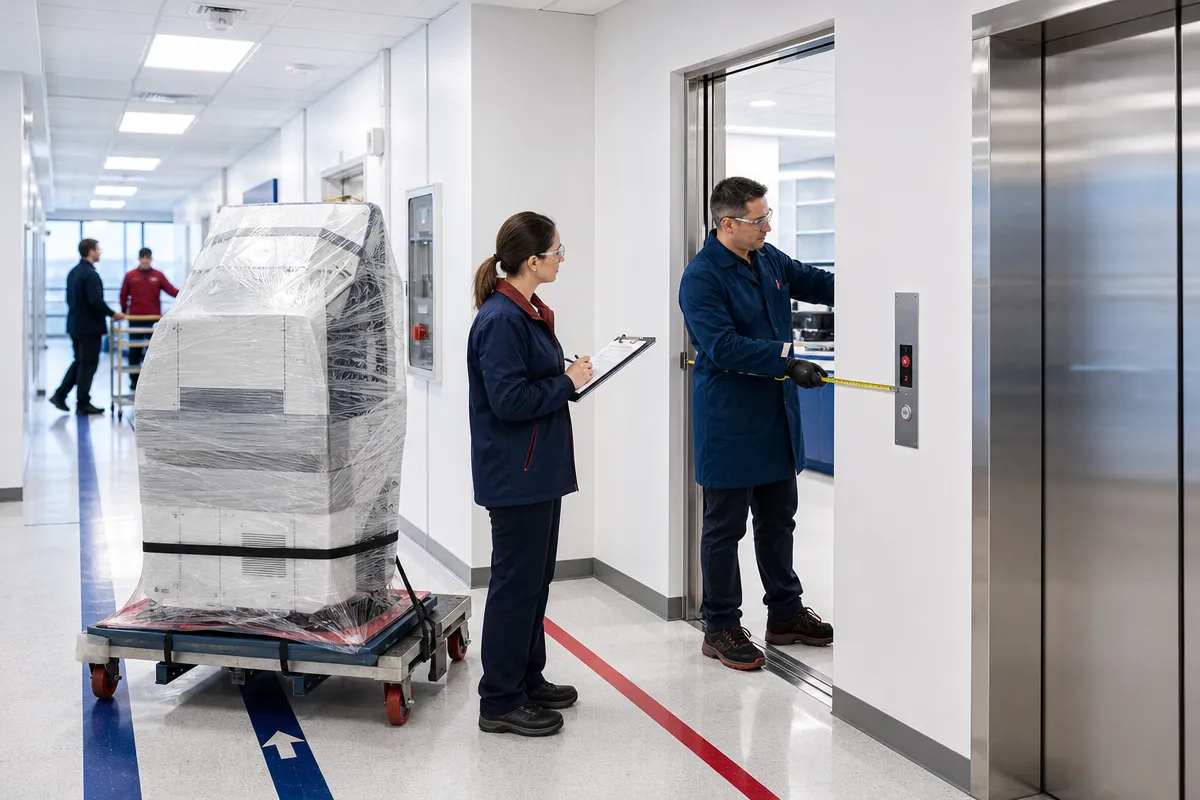
Lab equipment moving requires more than careful lifting and reliable transportation. Sensitive scientific instruments can be affected by shock, vibration, temperature changes, utility mismatches, contamination, missing accessories, and skipped calibration steps. A successful relocation starts with technical planning before anything is packed.
At RCS Commercial Moving & Warehousing, we support commercial moving, storage, logistics, and installation needs for organizations across Virginia and North Carolina, including Richmond, Charlotte, Raleigh, and surrounding service areas. If your team has questions about planning a laboratory relocation, reach out to our team.
A pre-move equipment audit gives every instrument a clear relocation plan
The first step in a laboratory relocation is an instrument-by-instrument audit. The inventory should identify each asset by manufacturer, model, serial number, asset tag, dimensions, weight, configuration, operating condition, calibration status, service history, replacement value, destination room, and manufacturer-specific transport requirements.
This audit is not just an administrative task. It determines which items need special handling, which vendors must be involved, and which assets should not move at all. The NIH guidance on Moving Your Laboratory Safely recommends disposing of unwanted equipment and materials before relocation and prohibits transporting laboratory waste as part of the move.
Sensitive instruments should be classified by risk. Analytical balances, centrifuges, chromatography systems, mass spectrometers, microscopes, imaging systems, freezers, biosafety cabinets, fume hoods, cryogenic systems, and radiation-producing equipment may each have different tolerances for vibration, humidity, temperature, orientation, electromagnetic exposure, or downtime.
Photographs and labels help prevent reassembly problems
Before disassembly, photographs create a useful record of cable connections, tubing, component placement, instrument condition, and configuration. Every removable component, cable, accessory, and container should receive a matching identifier. Crate numbers and contents should also be tracked in a running inventory.
The strongest audits connect each asset to a practical move decision. That means identifying what requires OEM support, what needs custom crating, what needs controlled transport, and what must be recalibrated or requalified before use.
OEM, vendor, calibration, and safety coordination should be scheduled early
Moving high-value scientific equipment often depends on manufacturer or vendor involvement. Laboratory equipment movers can support the physical relocation plan, but they do not automatically replace the manufacturer’s service team. Equipment under warranty or service contract should be reviewed with the vendor before it is moved, because moving it without vendor involvement can compromise warranty coverage.
Some instruments may need OEM shutdown, deinstallation, disassembly, preparation, packing, or reinstallation. NIH identifies HPLC systems and ultracentrifuges as examples of equipment that may need to be serviced and packed by the manufacturer or its representative before relocation.
The project schedule should include time after delivery for reassembly, reconnection, stabilization, calibration, and validation. UC San Diego’s equipment relocation guidance notes that a tissue-culture incubator should run for at least 12 hours after reconnection before calibration, while centrifuges must be rebalanced before use.
Define who releases each instrument for use
For regulated or quality-critical environments, the plan should identify whether the OEM, a metrology provider, or qualified in-house personnel will complete calibration verification or Installation Qualification, Operational Qualification, and Performance Qualification, commonly called IQ/OQ/PQ.
Acceptance criteria should be established before the move. Pre-move baselines give the receiving team something concrete to compare against after installation. An instrument can look undamaged and still require calibration correction before returning to production, research, clinical, or quality workflows.
This is also where RCS can fit into the broader relocation plan. Our role in commercial moving, logistics, warehousing, and installation can align with vendor schedules, facility access, staging needs, and physical move requirements while technical specialists manage instrument-specific service steps.
Destination readiness protects equipment before it ever leaves the lab
Destination readiness should be verified before equipment is loaded. A documented site survey should confirm room dimensions, floor loading, door and elevator clearances, turning radii, loading docks, staging areas, ceiling height, corridor restrictions, and the full rigging path from vehicle to final placement.
Utilities are just as important as clearances. The new location may need electrical capacity, emergency power, dedicated circuits, grounding, water, drainage, compressed gases, vacuum, process cooling, exhaust, data connections, network access, environmental controls, liquid nitrogen, or carbon dioxide supplies. If these are not ready, the move may pause at the most expensive point, after equipment has already been disturbed.
Layout affects both safety and performance. Instruments may need manufacturer-specified clearances, service access, suitable airflow, protection from heat sources and drafts, and separation from vibration sources. Lab Manager notes that sunlight and heating or cooling vents can affect instrument performance after installation.
Safety-critical systems need separate destination checks
Not every system can be plugged in and used immediately. Biosafety cabinets require post-move recertification before use, and fume hoods require inspection and certification. Seismic restraints may need to be removed and reinstalled. Freezers require suitable electrical service and, when applicable, emergency power and remote temperature monitoring.
Before packing begins, equipment must also be cleaned, decontaminated, drained, defrosted, or otherwise prepared according to its hazard profile and manufacturer instructions. Large equipment should be labeled with certification that it is free from hazards before relocation.
Chemical, biological, radioactive, and controlled materials need plans separate from the equipment move. Chemicals and compressed gases transported off campus fall under applicable Department of Transportation requirements, while biological materials may require institutional biosafety review, secondary containment, labeling, and documented custody.
Custom crating, transport controls, and chain of custody reduce relocation risk
Packing for sensitive laboratory equipment should be based on the instrument’s weight, geometry, fragility, value, orientation limits, and vibration tolerance. Precision instruments may require custom-built crates, internal blocking and bracing, vibration-isolating foam, anti-static materials, moisture protection, shock-absorbing mounts, skids, and dedicated handling points.
Loose or vulnerable components should be removed when the OEM specifies it and packed separately. Cables, connectors, lenses, probes, sample stages, rotors, and accessories should be bagged, tagged, photographed, and matched to the parent instrument. Crates should show origin, destination, orientation, handling instructions, and equipment identification.
Transport planning should address risk during loading, vehicle movement, unloading, and final placement. Specialty moves may require air-ride vehicles, controlled loading procedures, lift gates or cranes, forklifts, gantries, and other rigging equipment selected for the load and route.
A strong rigging plan should be specific enough that every critical move has a defined method. It should identify load-bearing points, center of gravity, lifting limits, floor protection, exclusion zones, and the qualified person directing the lift or placement. These details reduce guesswork when the instrument is already suspended, staged, or moving through a tight path.
For especially sensitive assets, monitoring can provide an auditable transit record. Packages may include shock indicators and data loggers recording acceleration, temperature, and humidity. GPS tracking and environmental monitoring can help receiving staff review conditions before unpacking or commissioning.
Documentation should follow the instrument through final acceptance
A controlled chain of custody should follow each sensitive instrument from pre-move inspection through deinstallation, packing, handoffs, delivery, unpacking, installation, and acceptance. Transfer records should identify the asset, condition, crate or package number, responsible person, date, time, location, and any exceptions or damage.
The documentation package may include:
Pre-move audit records and photographs
Calibration and service records
Decontamination certificates
Packing specifications and crate inventories
Rigging plans and handoff records
Environmental monitoring data
Delivery inspection notes
Installation, calibration, qualification, and acceptance records
At the destination, the receiving team should inspect crates before unpacking, compare condition against the pre-move record, photograph damage or missing components, and review shock, temperature, and humidity data. Any threshold exceedance should be escalated before the instrument is powered on.
Commissioning then proceeds in stages. IQ verifies correct installation, utilities, clearances, environmental conditions, and component completeness. OQ verifies operation within specifications. PQ, when required, confirms performance under intended use. CASRAI identifies backup power and temperature logging as elements of a validated cold-chain plan, along with a defined maximum excursion window and sequenced moves.
Final release should include calibration certificates, validation records, updated asset and location data, unresolved-defect logs, maintenance schedules, and owner acceptance. Lab Manager emphasizes that an instrument may appear physically undamaged while still having lost calibration or performance during transport, so post-move measurements should be compared with pre-move results.
Planning a laboratory relocation requires careful coordination among equipment owners, facilities teams, safety personnel, OEMs, vendors, and qualified movers. If your organization needs support with moving lab equipment, logistics, warehousing, or installation across Virginia or North Carolina, Request a Quote or call us today at (804) 358-4035.