


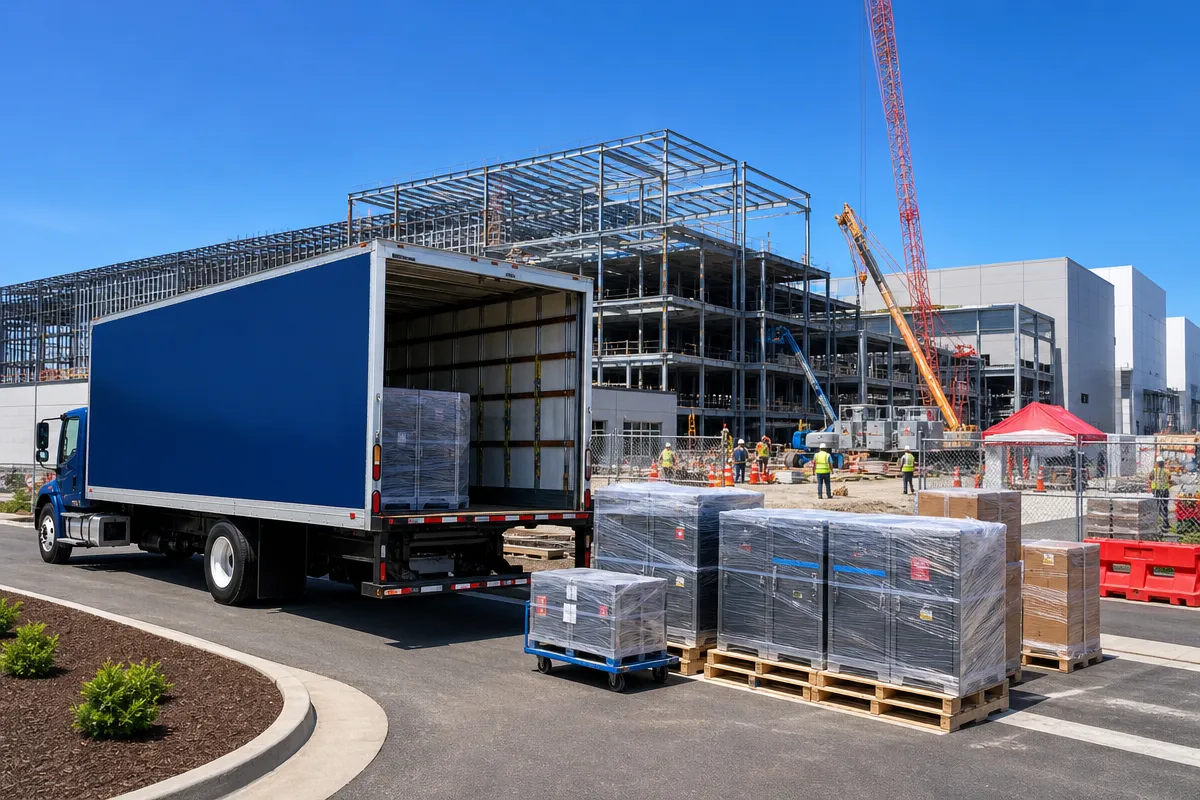
Data center construction news across Virginia, North Carolina, and the broader Southeast points to a fast-growing market shaped by power access, permitting pressure, community scrutiny, and complex logistics. For businesses near proposed campuses, contractors supporting construction, and facilities teams planning office or warehouse moves, these developments can affect timelines long before a facility opens.
At RCS Commercial Moving & Warehousing, we support commercial moving, storage, logistics, and installation needs across Virginia and North Carolina, including Richmond, Northern Virginia, Charlotte, Raleigh, and surrounding markets. If your team has questions about planning around a relocation, staging, or storage need, reach out to our team.
Virginia and North Carolina remain central to data center growth
Northern Virginia continues to dominate the U.S. data center market. The region has more than 4,900 MW of capacity, while North America had 7,481.1 MW under construction in the first half of 2026, up 24.8% in six months. Vacancy in major markets was only 1.4%, showing how tight the market remains.
The South is also carrying a major share of planned development. The region contained 754 planned data centers, nearly half of the U.S. total. North Carolina had approximately 800 MW of operating capacity as of December 2025 and an estimated 6,300 MW either planned or under construction.
Virginia’s scale is visible across multiple counties. By November 2026, Virginia had 707 facilities listed on Data Center Map. Recent examples include Stafford County’s Project Sisson, EdgeCore’s expansion in Louisa County, QTS adding a fifth building near Richmond, Google’s proposed centers and substations in Chesterfield County, and Project Raspberry in Botetourt County.
For relocation and warehousing planning, demand does not begin at occupancy. It starts during site preparation, road and utility work, contractor mobilization, office trailer setup, equipment delivery, and phased construction. Each stage can create needs for temporary storage, receiving, inventory control, final-mile coordination, and support-space installation.
Campus development creates work around the site, not only inside the server halls
Data center projects are often discussed as technology infrastructure, but their physical footprint is large and operationally complicated. Campuses may include buildings, substations, internal roads, utilities, parking, and stormwater systems, requiring nearby businesses, vendors, contractors, and public agencies to coordinate space, access, and movement.
Site selection depends on power, land, utilities, and highway access
Developers are focusing on sites that combine large, flat parcels with power, fiber, water, wastewater capacity, and highway access. Those criteria shape where projects are viable, how quickly construction can begin, and whether the surrounding road and utility network can handle the work.
Local planning materials describe the need for power, fiber, water, and transportation access as core considerations. These same factors matter to businesses and service providers working around a project. A site near established highways and industrial areas may be easier to support than a constrained location that requires appointment scheduling, off-site staging, escort coordination, or temporary laydown space.
Power availability can determine whether a project moves from announcement to active construction. Virginia’s JLARC review found that access to power and large, flat sites is decisive, while inadequate planning has sometimes placed facilities near residential areas. That creates friction when a project needs transmission infrastructure, substations, buffers, or road changes.
Commercial teams should treat early announcements carefully. A proposed development may still lack site control, utility access, zoning approval, water capacity, environmental permits, or a construction start. The practical approach is to classify projects by stage rather than headline value.
A useful project-tracking process should separate activity into planning milestones. This helps facilities, real estate, and operations teams decide when to engage movers, warehouse providers, installers, and freight partners.
Announcement of a proposed campus or expansion
Land or site control
Zoning application or special-use process
Environmental permitting and wetland review
Utility commitments and power-delivery planning
Construction start and site mobilization
Fit-out, commissioning, and occupancy
Project stage matters more than project size for relocation planning
A large announcement can create interest, but relocation and warehousing decisions become more reliable when zoning, utilities, permitting, and construction schedules are defined. Businesses planning around nearby development should watch for those signals before assuming a fixed move date.
Permitting, zoning, and community review are reshaping construction schedules
Large data center facilities commonly require zoning approvals, special-use permits or conditional zoning, site-plan review, stormwater permits, wetland authorizations, utility approvals, and substation permissions. These requirements can stretch timelines, especially when a project includes a full campus rather than a single building.
Public notices from the U.S. Army Corps of Engineers show that applications increasingly include buildings, substations, internal roads, parking, utilities, and stormwater ponds. This broad scope affects approval timelines, construction access, deliveries, and staging.
In Virginia, Loudoun County now requires a special exception for most data centers in industrial districts. Prince William County uses a Data Center Opportunity Zone Overlay to direct development toward locations with electrical service, buffering, and transportation access. Virginia’s 2026 Executive Order 22 also directs greater community transparency and bars state site-readiness or expedited-permitting assistance for new projects with anticipated peak demand of at least 25 MW.
North Carolina is also moving toward more detailed review. Senate Bill 730 requires site assessments before local approval of many new data centers, including analysis of sound effects on nearby residences and schools. Localities may also examine water, air quality, thermal plumes, agriculture, parks, historic sites, and forestland.
Community response has become a central development risk. Opposition often focuses on noise, diesel generation, visual scale, water use, electricity demand, transmission infrastructure, environmental impacts, and proximity to homes. Public hearings and conditional zoning proceedings give residents and local governments opportunities to challenge design, buffering, operating conditions, and infrastructure assumptions.
For businesses near proposed campuses, these public processes can have practical consequences. A relocation caused by land assembly, road improvements, utility work, or industrial property conversion may shift as hearings continue. Storage timelines may lengthen, and furniture liquidation or warehouse reconfiguration may need to happen in phases.
Local moratoria can delay related business moves
Recent local moratoria reported in North Carolina include Chatham County, Charlotte, Raleigh, Rowan County, Beaufort County, and Boone, with adoption dates ranging from February through October 2026. These pauses can lengthen site-selection and construction schedules, create uncertainty for contractors, and delay relocation work connected to proposed campuses.
Construction delays create repeat demand for storage, staging, and installation support
Data center construction relies on specialized components, including generators, transformers, switchgear, chillers, cooling equipment, batteries, racks, cable, controls, prefabricated assemblies, and building materials. These items do not always arrive when the site is ready. When construction, utility, or commissioning timelines shift, the logistics plan has to shift with it.
Power availability is the largest reported obstacle to on-time delivery. In Turner & Townsend’s 2025-26 survey, 48% identified power availability as the primary constraint. More than half of data center projects in 2025 experienced delays of at least three months, according to JLL. Those delays can trigger warehouse extensions, rescheduled deliveries, idle trailers, and staggered office or support-space installations.
Advanced cooling is another bottleneck. Eighty-three percent of Turner & Townsend survey respondents said local supply chains were not ready for advanced cooling systems. As projects shift toward liquid cooling and other high-density thermal-management systems, they require specialized contractors, controls, electrical integration, commissioning, and protected handling.
Labor shortages compound these challenges. Turner & Townsend’s 2026-27 index found that 81% of respondents saw skilled labor as constrained. In the Associated General Contractors’ 2025 workforce survey, 45% of firms reported project delays caused by worker shortages.
This is where commercial moving and warehousing support can reduce friction. RCS Commercial Moving & Warehousing works with businesses that need secure storage, phased moving, office setup, equipment handling, and logistics coordination when schedules change across Virginia and North Carolina.
The most practical opportunities often sit outside the secure server halls. Office furniture, modular offices, training rooms, security buildings, operations centers, break rooms, maintenance shops, contractor trailers, and employee amenities all need to be delivered, assembled, moved, stored, or removed at some point in the project lifecycle.
Delayed equipment often creates delayed occupancy work
When electrical or cooling systems slip, the effect can reach support spaces that seemed separate from the critical path. A facilities team may need to hold furniture, reschedule installation crews, relocate temporary offices, or keep a nearby warehouse active until commissioning is complete.
Sustainability, cooling, and water rules add new logistics considerations
Data centers consume substantially more energy than typical commercial or industrial operations, and Virginia reviews identify water demand as a growing management issue. Power and water affect site viability, substation construction, transmission schedules, operating costs, zoning negotiations, and the timing of dependent trades.
Cooling requirements are becoming more demanding as artificial-intelligence workloads increase rack density. North Carolina legislation and proposed policy specifically address closed-loop, reclaimed-water, or liquid-cooling systems and restrict or discourage water-intensive evaporative approaches for covered facilities. Senate Bill 730 also directs state water-use standards toward protection of surface and groundwater resources.
North Carolina’s House Bill 1063 would require preconstruction disclosures, certificates of operation, on-site clean-generation capacity equal to at least 25% of projected peak demand, and closed-loop or reclaimed-water systems where practicable. These requirements may increase demand for specialized installers, commissioning technicians, leak-detection systems, water-treatment services, and protected storage for cooling components.
Stormwater and wetland compliance also affects movement on and around a site. Large campuses create extensive roofs, roads, parking areas, substations, and utility corridors. Permitting may influence when access roads are usable, where material can be staged, and which entrances or temporary routes are available for movers and freight carriers.
For commercial teams, sustainability requirements can translate into practical handling needs. These details should be built into project plans early, especially when a construction schedule includes multiple vendors, split deliveries, or reusable materials.
Reusable crates for office or equipment-related moves
Packaging recovery and removal after deliveries
Controlled storage for cooling and electrical components
Documented chain-of-custody procedures
Consolidated loads to reduce unnecessary trips
Coordination around stormwater, wetland, and access limitations
Environmental review can change where and when crews can work
Access is not always fixed on a data center campus. Drainage work, wetland boundaries, road construction, and utility corridors can affect delivery sequencing. A flexible storage and staging plan helps teams keep materials moving without forcing everything onto the site too early.
Businesses should plan for phased moves around data center construction
Data center growth creates a multi-stage service market. Activity may begin with land acquisition and tenant displacement, then continue through construction-site logistics, contractor and vendor warehousing, office and support-space setup, commissioning support, and post-occupancy expansion. The strongest opportunities are likely near Northern Virginia, Richmond and central Virginia, Stafford and Louisa counties, the North Carolina Triangle, Charlotte, and major Southeast hubs such as Atlanta.
Nearby businesses may be affected even if they are not directly involved in the project. Campuses can consume industrial land, change traffic conditions, alter utility planning, or accelerate redevelopment of surrounding properties. Manufacturers, suppliers, contractors, and professional offices may need new premises, temporary swing space, records storage, furniture liquidation, or warehouse reconfiguration.
Timelines remain vulnerable to utility interconnection, special-use hearings, moratoria, environmental review, skilled-labor shortages, cooling-system availability, and delayed electrical equipment. Moving budgets and schedules should allow for change orders, split deliveries, extended storage, weather and permitting contingencies, and multiple mobilizations rather than assuming one simple move.
Facilities and operations leaders can reduce risk by identifying storage options before they are urgent, confirming which assets need to be moved versus liquidated, and building decision points around permitting or construction milestones. Contractors and vendors can benefit from having overflow warehouse space ready when manufacturing, delivery, installation, and final acceptance are separated by weeks or months.
Planning should also account for ordinary support spaces. General offices, security areas, training rooms, break rooms, warehouses, maintenance shops, contractor trailers, and employee amenities often need furniture, fixtures, files, supplies, and equipment delivered at different stages. Coordinating these details early helps prevent a construction delay from becoming a workplace disruption.
If your business is planning a move, storage need, installation project, or logistics support related to a data center project in Virginia or North Carolina, RCS Commercial Moving & Warehousing can help you prepare a practical plan. Get a Quote or call us today at (804) 358-4035.