


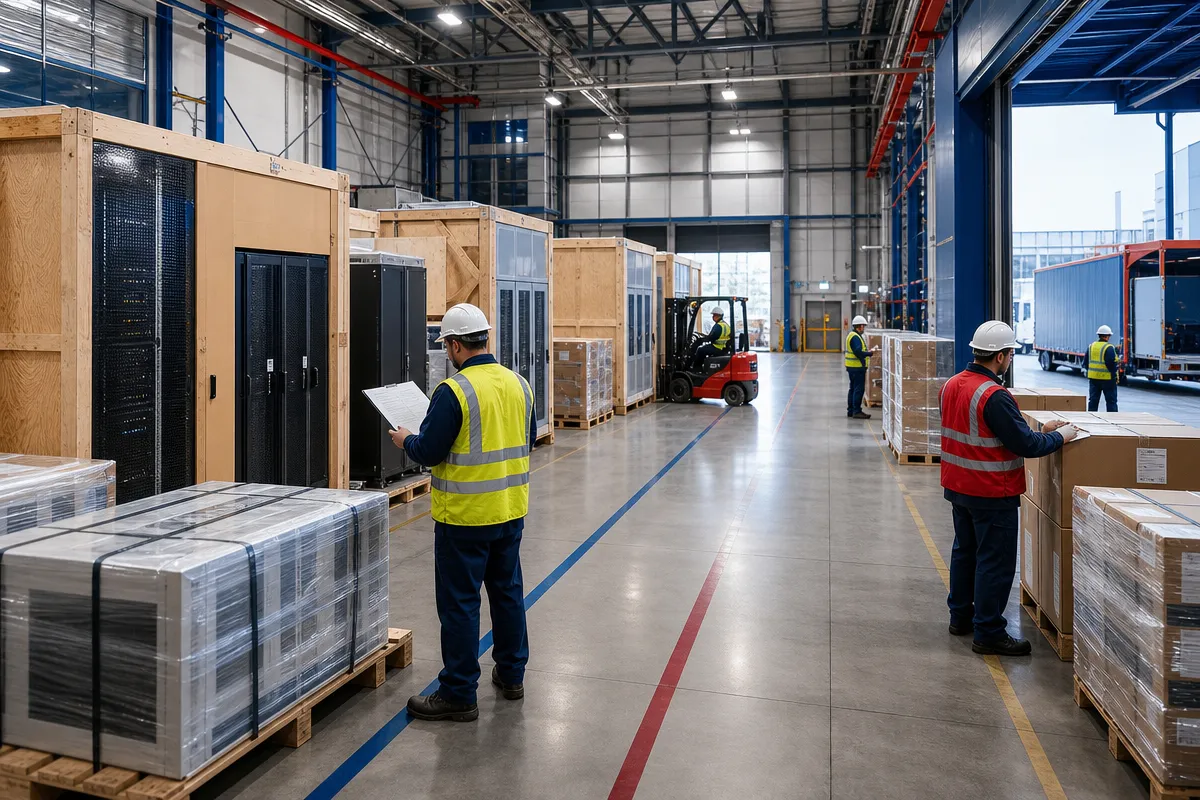
Oversized equipment delivery for data center projects is rarely just a transportation task. Generators, transformers, switchgear, UPS systems, chillers, air-handling equipment, busduct, and modular rooms can be oversized, overweight, high-value, vibration-sensitive, and difficult to replace quickly. A successful delivery plan has to account for the full movement, from vendor release through final placement and trade handoff.
Oversized data center equipment needs logistics planning before procurement is locked in
Large data center assets should be evaluated before the project team finalizes procurement and shipping decisions. Once equipment specifications, delivery dates, and construction sequencing are fixed, it becomes harder to change the plan if an access issue appears. Early logistics review gives the team time to confirm whether the equipment can physically reach the site and be received safely.
The delivery plan should cover the entire path of movement. That includes vendor release, carrier selection, route engineering, permits, escorts, site access, staging, crane or rigging availability, unloading, final placement, and handoff to the next trade. Treating the shipment date as the main milestone can leave important constraints unresolved until it is too late.
Timing matters because oversize and overweight moves often require more than a standard carrier booking. Permit processing may take two to four weeks, and experienced providers recommend allowing roughly 45 to 60 days for planning, route evaluation, capacity, permitting, and delivery coordination for oversized data center shipments.
Early planning reduces the risk of expensive delivery failures
When logistics input comes in early, the team can identify the correct trailer type, lifting method, delivery window, and site requirements before a truck is dispatched. It can also prevent a purchase order from locking in an equipment configuration that is hard to move, hard to unload, or incompatible with the jobsite sequence.
The practical rule is simple: bring in specialized logistics support before procurement, shipping, or jobsite scheduling becomes irreversible. Discovering after shipment that a truck cannot clear a route, turn through a gate, unload safely, or access a prepared pad can create delays, rehandling, congestion, and damage risk.
Site access checks must follow the load from the road to the final pad
A useful access assessment starts at the public road and follows the complete delivery path to the final setting point. The team should not stop at confirming that the truck can enter the property. A load may pass the gate and still fail at a turn, grade, dock, doorway, corridor, elevator, or final equipment pad.
Accurate equipment drawings are essential. The logistics team needs the length, width, height, gross weight, center of gravity, lifting points, securement points, skid or base configuration, and any tilt, vibration, or orientation restrictions. These details guide decisions about trailer selection, axle configuration, blocking, tie-down patterns, lifting equipment, and unloading method.
Operational rules also affect delivery success. Site teams should confirm gate hours, badging, driver orientation, PPE, escort requirements, truck-size limits, appointment procedures, delivery windows, communication contacts, and who has authority to accept the equipment. They should also document who is responsible for cranes, rigging crews, forklifts, spotters, traffic control, and final placement sign-off.
Before approving a delivery date, the project team should evaluate physical access, site rules, and readiness together. A prepared checklist helps expose issues that may not appear on the construction schedule. These checks are especially important when multiple vendors, trades, and heavy vehicles share the same site.
Confirm gate dimensions, approach roads, turning radii, grades, and pavement strength.
Check overhead obstructions, bridges, culverts, underground utilities, and construction traffic patterns.
Verify docks, building entrances, freight elevators, corridors, ramps, and final placement tolerances.
Identify laydown areas and confirm whether they will be available when the load arrives.
Confirm that the equipment pad, room, or installation area is ready to receive the asset.
Site readiness is as important as physical access
A generator may arrive before its pad is cured. Switchgear may arrive before the electrical room is weather-tight. A chiller may arrive before the crane or mechanical installation crew is available. In each case, the truck may have reached the site, but the project has not truly created a safe receiving condition.
Heavy-haul route planning, permits, and trailers must match the actual load
Route engineering evaluates the specific load, trailer, axle configuration, dimensions, and legal requirements against the physical route. The review should identify bridge heights and weight ratings, roadway widths, turning radii, grades, railroad crossings, low clearances, utility lines, construction zones, traffic restrictions, and permit-restricted travel hours.
A desktop review can support early feasibility decisions during design, bidding, procurement, or carrier selection. For critical moves, a physical route survey is more reliable because it verifies actual clearances and obstructions in the field. Measurements and photographs can help the project team understand risks before equipment is released for shipment.
Heavy transformers and other superloads may require bridge-by-bridge structural review, utility-line lifts, police or pilot-car escorts, road closures, and coordination with state or local authorities. Federal rules provide baseline limits, but the federal government does not issue the permits needed for most oversized moves. The FMCSA oversize and overweight permitting guidance notes that states and local jurisdictions establish requirements for these moves.
A shipment crossing multiple states generally requires permits in each state. Thresholds, fees, routes, escort rules, and travel hours can vary by jurisdiction. For data center projects, that variability needs to be reflected in the schedule instead of treated as a last-minute administrative step.
Trailer selection should consider both the road and the jobsite
Different assets may require different equipment. Smaller components may move in dry vans or straight trucks, while generators, transformers, switchgear, chillers, UPS modules, and modular assemblies may require flatbeds, step-decks, removable goosenecks, hydraulic lowboys, multi-axle platforms, or specialized heavy-haul trailers.
The correct trailer is not determined by road legality alone. A low trailer may be needed to clear bridges and overhead lines. A multi-axle platform may be needed to distribute weight across pavement and bridges. The trailer configuration may also need to support crane access, side loading, rear unloading, or a controlled roll-off operation.
This is the point where RCS Commercial Moving & Warehousing often fits naturally into the project team’s planning. Our role can include coordinating moving, warehousing, cross-docking, logistics, and installation-related support so the delivery plan aligns with the site’s actual receiving conditions.
Staging, unloading, and final placement should follow the construction sequence
Delivery sequence should follow the construction sequence rather than vendor convenience. One documented data center program coordinated approximately 90 to 95 truckloads and began final deliveries with structural racking, followed by medium-voltage switchgear and generators. The team also validated truck equipment, driver credentials, site hours, and daily truck limits.
Off-site staging becomes valuable when the jobsite is incomplete, congested, unable to receive multiple trucks, or not ready for installation. A forward warehouse or cross-dock can receive vendor shipments, inspect and consolidate loads, protect equipment, and release each item only when the project can safely accept it.
A staging plan should be developed before procurement if storage may be needed. The team should specify storage duration, indoor or outdoor requirements, security, weather protection, insurance, battery or fuel restrictions, environmental controls, preservation inspections, inventory tracking, and the process for moving equipment from storage to the site.
Cross-docking is useful when equipment needs little storage but must be transferred between transportation legs or consolidated into a site-ready delivery sequence. Instead of sending all freight to an unprepared construction site, a nearby facility can release items in phased deliveries that match site readiness.
Unloading plans need assigned responsibilities before dispatch
Before the load moves, the unloading method should be engineered and assigned. The plan should identify crane capacity and radius, forklift or gantry requirements, ground-bearing capacity, outrigger locations, rigging points, lifting lugs, spreader beams, tag lines, exclusion zones, weather limits, traffic control, and the person responsible for directing the lift.
Rigging crews should verify the center of gravity, approved lifting points, shipping braces, crate or skid condition, and manufacturer-specific handling restrictions. Incorrect rigging can deform enclosures, damage switchgear, shift internal components, compromise UPS systems, or create a dropped-load event.
The final travel path inside the facility also needs review. Floor loading, dock levelers, ramps, freight elevators, door openings, corridors, raised floors, and placement tolerances can all affect how equipment is moved into position. Heavy assets may require steel plates, cribbing, rollers, air casters, hydraulic skates, temporary flooring, or other load-distribution measures.
Final placement should be coordinated with the electrical, mechanical, structural, and commissioning teams. Equipment should be set, leveled, oriented, anchored or secured as required, protected from construction activity, and formally handed off with condition records and acceptance documentation.
If your project involves oversized equipment delivery, early planning can prevent avoidable delays, access conflicts, and rehandling. RCS Commercial Moving & Warehousing can help with commercial moving, warehouse storage, cross-docking, logistics and freight, installation services, and related project support. Request a Quote through our contact page, email us at contact@rcsmoving.com, or call us today at (804) 358-4035.