


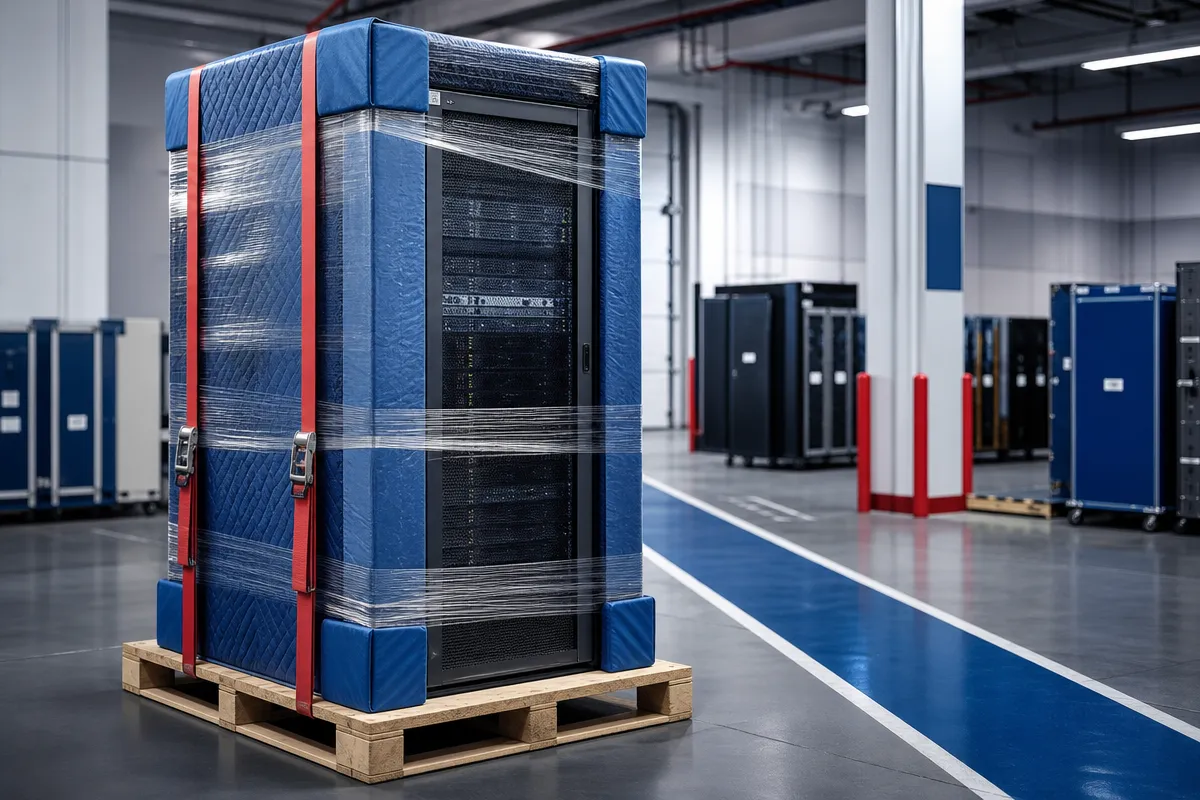
Data center storage is not ordinary warehousing. During a relocation, construction project, facility fit-out, technology refresh, decommissioning program, or phased deployment, servers, racks, storage arrays, network equipment, power systems, cabling, and accessories may need a secure place to wait before they can move into the final white-space location.
Secure short-term storage protects IT equipment while project schedules catch up
Short-term storage for data center equipment is often needed because the destination site is not ready at the same time the equipment arrives. Power, cooling, fire protection, pathways, loading access, rack anchoring, security approvals, and network infrastructure may still be in progress. Storage gives the project team a controlled buffer instead of forcing equipment into an unfinished environment.
The key is to treat the warehouse as part of the deployment process, not as a holding area disconnected from the project. Mission-critical IT assets should be protected from theft, unauthorized access, impact, dust, moisture, temperature swings, humidity, static discharge, and unnecessary handling. That requires planning before equipment arrives.
A secure storage plan should identify who can access the assets, how custody is recorded, what condition checks are performed, and when equipment can be released. It should also define what happens if a shipment arrives damaged, incomplete, mislabeled, or earlier than expected.
For data center equipment, storage controls usually need to account for:
Controlled entry and restricted storage areas for high-value assets.
Video surveillance, visitor records, and documented custody transfers.
Clear separation between inspected equipment and equipment with unresolved exceptions.
Protection from loading-dock traffic, construction dust, uncontrolled pedestrian access, and unnecessary forklift movement.
Defined release authorization so assets do not leave storage before the site is ready.
These controls help project teams maintain schedule flexibility without losing visibility. When equipment is stored under a documented process, IT, facilities, construction, and vendor teams can coordinate deployment waves with greater confidence.
Environmental controls and packaging reduce avoidable storage risk
Servers, GPUs, storage systems, switches, UPS equipment, batteries, and power-distribution hardware may have different environmental and packaging requirements. Storage planning should account for temperature and humidity needs, protection from condensation, and procedures that reduce electrostatic or moisture-related damage. The right approach depends on the equipment type, packaging condition, and project requirements.
One of the most important distinctions is between ordinary commercial storage and mission-critical IT staging. Racks and servers should not be placed in areas where roof leaks, dust, dock congestion, heavy equipment traffic, or uncontrolled access can expose them to avoidable risk. Equipment should remain palletized, crated, or otherwise protected when it is not being inspected, staged, or deployed.
Packaging also needs to support both protection and workflow. Original shipping packaging, custom crates, blocking and bracing, protective covers, palletization, upright positioning, and shock or tilt indicators may be appropriate depending on manufacturer requirements. The goal is to preserve condition while still allowing inspection and efficient release when the destination is ready.
A storage agreement should define receiving condition, permitted access, environmental monitoring, inspection frequency, insurance responsibilities, emergency procedures, and release authorization. Environmental logs, condition photographs, seal records, and exception reports give the project team evidence that equipment remained protected during its dwell time.
The physical storage environment is only one part of readiness. Teams also need receiving procedures that document the package condition before opening, photograph assets after uncrating, retain serial and crate associations, and preserve reusable packaging when return shipment or later redeployment is expected.
Inventory, serial control, and chain of custody keep assets traceable
Good storage practices for data center equipment depend on knowing exactly what is in storage, where it is located, who handled it, and when it is approved for release. A useful inventory should go beyond a basic count of boxes or racks. It should connect each asset to its project role, destination, and handling status.
At a minimum, a data center inventory should identify the asset or serial number, manufacturer, model, asset tag, rack position, crate or pallet number, destination, ownership, condition, dimensions, weight, and warranty or disposition status. It should also account for rails, power cords, cables, licenses, accessories, and undocumented hardware that could otherwise become separated from the primary device.
This level of control matters because deployment delays often come from missing dependencies. A rack might not be ready for release if its rails, PDUs, cabling, transceivers, labels, installation hardware, or vendor documentation are missing. Storage records should make these gaps visible before assets reach the jobsite.
Strong custody records should capture each movement event in the asset’s path:
Receipt from the carrier, including delivery time and package or seal condition.
Inspection results, visible damage, shortages, or labeling issues.
Movement into a warehouse location, secure zone, quarantine area, or staging lane.
Release into an outbound vehicle or deployment wave.
Delivery to the site and final rack placement location.
Barcode, serial number, RFID, or equivalent controls can connect each asset to its rack, room, row, project phase, installation priority, and release order. At each custody transfer, the record should show who handled the asset and when. This documentation helps IT and facilities teams reconcile the original manifest with final placement.
Exception handling is just as important as inventory accuracy. Damaged packaging, crushed corners, broken shock indicators, moisture evidence, missing labels, shortages, and visible chassis or rack damage should be photographed and quarantined until the owner, carrier, vendor, or project manager decides whether the equipment is accepted, repaired, replaced, or released.
Rack and network equipment handling should follow a defined movement plan
Storage for server racks and network racks requires more than open floor space. Rack handling begins with a site-specific method of procedure that accounts for dimensions, weight, center of gravity, casters, ramps, floor transitions, turning radii, door and elevator clearances, lifting equipment, approved routes, static-control requirements, and manufacturer instructions.
Racks and integrated systems should be secured against movement before transport. Depending on the equipment and manufacturer requirements, the plan may involve original shipping packaging, custom crates, blocking and bracing, protective covers, palletization, upright positioning, and movement practices that reduce vibration risk. These steps help protect the equipment during receiving, storage, internal movement, and final placement.
The warehouse layout should also support safe handling. Inbound receiving, inspection, quarantine, secure storage, deployment staging, packaging and crating, outbound dispatch, and returns or disposition areas should be clearly separated. Safe forklift and cart routes, adequate turning space, protected pedestrian paths, dock controls, and separation between inspected and unresolved equipment reduce the chance of avoidable handling issues.
This is where physical deployment support connects naturally to storage. RCS crews can support unloading, inspection, uncrating, staging, rack placement, IT coordination, documentation, and closeout as part of a controlled deployment workflow, while technical validation remains with commissioning authorities, IT teams, OEMs, and technical trades.
That separation of responsibilities is important. Physical movers can position, align, level, and secure racks, but IT or OEM personnel remain responsible for technical installation, configuration, power-up, cabling, functional validation, and operational acceptance. Clear scope prevents confusion during high-pressure deployment windows.
Handling plans should also consider what happens after uncrating. Packaging removal, debris control, staging order, access pathways, and closeout photographs all affect the project. If reusable packaging is needed later, it should be preserved and tracked instead of discarded during the first handling event.
Staged release and cross-docking">cross-docking align storage with construction and commissioning
Storage support is most valuable when it aligns with the project schedule. Storage should not simply hold assets until someone asks for them. It should organize equipment by deployment wave, facility, building, room, floor, row, rack, vendor, and installation priority so release groups can be built accurately.
Staged release planning links warehouse withdrawals to construction, commissioning, installation, and maintenance schedules. The release record should specify the destination, rack or room, required arrival window, carrier, appointment, asset list, packaging condition, custody transfer, and receiving contact. This gives both the warehouse and the site team a shared understanding of what is moving and why.
Cross-docking can reduce storage dwell time by moving inbound freight directly into an outbound deployment wave when the timing is right. It requires accurate manifests, secure temporary staging, appointment coordination, inspection, rapid shortage or damage reconciliation, and a clear distinction between equipment approved for release and equipment requiring quarantine.
The process works best when responsibilities are assigned early. The transportation provider, warehouse, commercial mover, general contractor, OEM, integrator, IT team, facilities group, security team, and commissioning authority all need to understand their roles. That includes who books freight, manages insurance, tracks custody, schedules appointments, accepts shipments, and controls equipment after arrival.
External logistics providers describe the same need for coordinated handling in data center environments, where data center logistics must connect transportation, storage, and deployment activity. In practice, that means the warehouse becomes a schedule-control point. Assets can remain secured until loading-bay access, freight-elevator availability, floor protection, power, cooling, fire protection, network pathways, and security approvals are ready.
Staged release also helps prevent asset mixing. Complete kits can be assembled before dispatch, and unresolved items can stay in quarantine instead of traveling to the site and delaying installation. The project team gains better control over what arrives, when it arrives, and whether it is ready for the next step.
Final handoff documentation turns storage activity into operational readiness
The final handoff should reconcile the original manifest, warehouse inventory, serial numbers, rack placement, damage reports, custody records, packaging status, release records, photographs, and unresolved exceptions. This documentation allows IT and facilities teams to verify that the right equipment reached the intended rack and that accessories, cables, and components were not lost during storage or movement.
A controlled punch list should identify the asset or rack, location, issue, severity, responsible party, corrective action, due date, status, evidence, and acceptance authority. Typical issues may include incorrect rack position, unlevel racks, blocked pathways, labeling errors, cable defects, missing accessories, power or network faults, incomplete vendor work, and documentation gaps.
Daily reporting, rack-placement logs, exception tracking, photographs, quality-control records, and client sign-offs give project managers visibility while keeping technical responsibility in the proper hands. Storage and deployment teams can document physical handling and placement, while IT, OEM, commissioning, and facilities teams confirm configuration, testing, commissioning, and operational acceptance.
This approach is especially important in projects where downtime, sequencing, and asset identity are tightly managed. Industry discussion around data center logistics in a zero-downtime world reinforces the importance of disciplined coordination across storage, transportation, and deployment activity.
The best storage plan treats the warehouse as part of the deployment control system. Secure storage protects equipment during schedule gaps. Inventory controls preserve identity. Environmental and packaging controls preserve condition. Rack-handling procedures reduce physical risk. Staged release, cross-docking, installation support, and closeout documentation connect storage to final operational handoff.
If your organization is planning a data center move, facility build, phased deployment, or short-term staging project, RCS Commercial Moving & Warehousing can help coordinate the physical storage and deployment support needed to keep assets protected and traceable. Request a Quote or call us today at (804) 358-4035.