


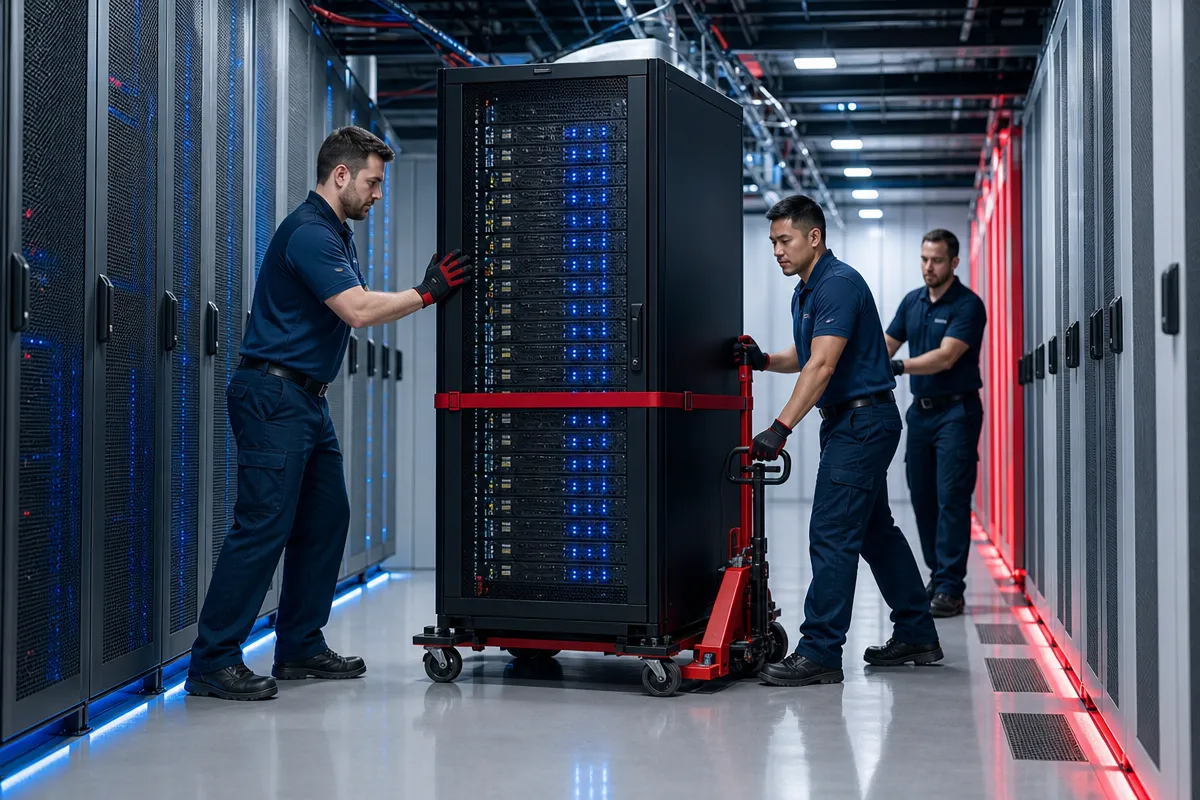
A data center migration is not simply a server move. It is the coordinated relocation or transformation of infrastructure, applications, data, networks, security controls, and operating processes from one environment to another. The destination may be a new facility, colocation site, renovated data hall, private or public cloud, or hybrid setup.
A successful data center migration starts with clear business goals and acceptance criteria
Every data center migration plan should begin with the reason the work is happening. Common drivers include ending a lease, consolidating facilities, improving power or cooling capacity, meeting compliance obligations, reducing costs, modernizing infrastructure, improving resilience, or moving selected workloads to cloud services.
Those goals should become measurable success criteria before execution begins. Without agreed criteria, teams can disagree during cutover about whether a system is ready, performance is acceptable, or rollback is required.
A strong plan defines maximum permitted downtime, recovery-point objective, recovery-time objective, performance thresholds, data-integrity checks, user acceptance testing, inventory reconciliation standards, and business-owner approval steps. The maximum permitted downtime should be known before the project team starts sequencing systems.
A data center migration has three connected workstreams
The technical team may lead application and infrastructure decisions, but the project can fail if logistics, facilities, communications, and governance are treated as secondary tasks. A complete data center migration process usually includes three parallel workstreams:
Technical migration: Servers, storage, networks, applications, databases, identities, security controls, and data.
Facilities and logistics: Site surveys, rack layouts, power, cooling, cabling, packaging, transportation, staging, warehousing, and installation.
Business continuity and governance: Communications, approvals, compliance, risk management, rollback, vendor coordination, and post-move support.
The project sponsor should have authority to make go or no-go decisions during cutover. Some decisions cannot wait for a large committee, especially when an outage threshold, failed validation test, or security issue has already been defined as a rollback trigger.
Data center migration discovery should verify assets, owners, and dependencies
Discovery is where many data center migration challenges begin. Teams often rely on old spreadsheets, incomplete configuration-management records, or informal knowledge held by a few people. A safer approach is to produce a verified inventory that can be reconciled, tracked, and used throughout the project.
The inventory should include physical servers, virtual machines, storage arrays, switches, firewalls, load balancers, racks, power-distribution equipment, appliances, licenses, applications, databases, data volumes, serial numbers, dimensions, weights, ownership, support status, and destination assignments. Records should be reconciled against the configuration management database, procurement records, support contracts, and application-owner information.
Each asset should receive a unique identifier that can be scanned during de-installation, loading, transport, receiving, staging, installation, and final reconciliation. This supports chain of custody, the continuous record of who handled each asset, when and where it was handled, and whether its condition changed. Strong relocation records include serialized scanning and signed handoffs from pickup through installation.
Dependency mapping prevents hidden failures during cutover
Dependency mapping identifies what must move, stop, start, or be tested together. For every application, the project team should document databases, file shares, authentication services, DNS, NTP, SMTP relays, license servers, external APIs, batch jobs, certificates, hardcoded hostnames or IP addresses, monitoring systems, backup services, and upstream or downstream integrations.
Network-flow data should be collected over a representative business cycle, including month-end or other peak periods. If the team only maps obvious server-to-server connections, it can miss scheduled jobs, legacy integrations, hardware-bound licenses, external connections, and infrequently used services that are still business-critical.
A practical dependency register should name the application or service, business owner, technical owner, supporting infrastructure, startup and shutdown order, data-transfer method, validation test, acceptance owner, recovery requirements, rollback trigger, migration wave, maintenance window, and communication group.
Backups need more than confirmation that they exist. Backup sets should be tested for restoration in the target environment. Creating backups without proving they can be restored does not establish recoverability.
The right data center migration strategy depends on downtime, risk, and destination readiness
There is no single data center migration strategy that fits every workload. Some systems may be physically relocated, replicated to a new facility, moved to cloud infrastructure, or handled through a mix of methods because applications, hardware, licensing, and business requirements differ.
A lift-and-shift approach moves workloads with minimal architectural change. It can reduce design time and preserve familiar configurations, but it may carry forward obsolete hardware dependencies, inefficient resource allocations, licensing issues, and existing performance or security weaknesses.
A phased migration moves systems in controlled waves. Low-risk or loosely coupled workloads can move first, while critical applications follow after the destination and procedures have been tested. Phasing reduces the size of each cutover, but it requires temporary coexistence, more coordination, and sometimes duplicated facilities costs.
A parallel build-out creates and tests the destination while the source environment remains operational. This can improve validation and rollback options because both environments can run concurrently. It also requires additional power, space, connectivity, staffing, licensing, and budget during the transition.
A hybrid migration combines approaches by workload. Stable virtual machines may be replicated, legacy systems physically moved, and suitable applications rehosted or refactored in cloud infrastructure. Hybrid plans must address identity, routing, security policy, data sovereignty, licensing, latency, and operational ownership across environments.
Strategy selection should be tied to specific constraints
The project team should not choose a method based only on convenience. A migration strategy should reflect application criticality, allowable downtime, RPO, RTO, replication capability, data volume, transfer time, dependency complexity, destination readiness, rollback feasibility, staff capability, vendor support, and business-calendar constraints.
For physical relocation, the logistics plan also affects strategy. Warehousing and cross-docking can reduce site congestion when the destination is not ready or equipment must arrive in waves. RCS can help align secure storage, cross-docking, transportation, and installation timing with the technical runbook, so equipment is not delivered before racks, power, cooling, access, and staging areas are ready.
A data center migration checklist should connect the runbook to facilities and logistics
A useful data center migration checklist is more than a list of technical tasks. It connects business objectives, infrastructure design, physical site readiness, transport controls, cutover steps, validation tests, and handoff requirements. It should also identify who owns each action and what evidence proves it is complete.
The project plan should name the executive sponsor, project manager, technical leads, facilities representatives, application owners, security and compliance representatives, logistics providers, transport coordinators, destination-site contacts, and post-move support personnel. The schedule should cover discovery, design, procurement, destination preparation, network and cross-connect installation, testing, pilot moves, migration waves, cutover, hypercare, decommissioning, asset disposition, and closeout.
The runbook should provide minute-by-minute execution instructions, named owners, expected results, communication points, validation tests, escalation paths, and rollback triggers. A rollback decision should be tied to objective conditions such as failed application tests, unacceptable latency, missing data, broken integrations, failed security controls, or an exceeded outage threshold. A strong data center migration checklist keeps those decisions from becoming improvised during a maintenance window.
Before the move, both sites should be surveyed for loading bays, lifts, doors, floor loading, routes, staging areas, security, power, cooling, and access controls. Destination readiness should also include racks, power circuits, cooling capacity, network connectivity, cross-connects, monitoring, fire suppression, and physical security.
A practical relocation checklist should confirm readiness before cutover
The checklist becomes most valuable when it forces teams to confirm readiness before equipment is touched. It should make unknowns visible, assign responsibility, and prevent late surprises. The following items are central to a data center relocation checklist:
Confirm scope, objectives, budget, sponsor, owners, and success criteria.
Complete physical, virtual, application, license, and data inventory.
Reconcile inventory with the CMDB and identify unknown or orphaned assets.
Map dependencies, network flows, IP addresses, VLANs, DNS, certificates, and firewall rules.
Confirm RPO, RTO, backup restoration, replication, and rollback procedures.
Survey both sites for loading routes, staging areas, access controls, power, cooling, and security.
Approve packaging, labeling, asset tracking, chain of custody, transport, and insurance procedures.
Establish migration waves, shutdown order, delivery sequence, installation sequence, and maintenance windows.
Rehearse technical and logistics procedures where practical.
Distribute the communications plan to employees, customers, vendors, help desks, and incident-management teams.
Conduct go or no-go review, execute the runbook, validate results, monitor during hypercare, and obtain formal handoff approval.
Physical relocation controls protect equipment, data, and project accountability
Physical relocation introduces risks that differ from application migration risks. Servers, storage, racks, and network equipment can be damaged, mislabeled, delivered out of sequence, or staged in the wrong place. Sensitive assets also require documented handling from removal through installation and reconciliation.
Before equipment moves, technicians should document serial numbers, asset tags, rack positions, front and rear photographs, cable connections, configuration state, condition, weight, dimensions, orientation, environmental limits, and special handling requirements. Cabling documentation should identify rack unit, panel, port, cable type, circuit, destination, labeling convention, and any fiber polarity or transceiver information.
The physical move should follow a controlled sequence. Teams should freeze changes, capture final configurations, shut down systems in dependency order, label and photograph equipment, de-rack or secure equipment using approved procedures, protect components with anti-static materials and cushioning, scan assets at pickup, load by installation sequence and weight-distribution plan, and use secured transportation.
On arrival, shipments should be inspected before packaging is opened. Serial numbers and photographs should be reconciled against the manifest. Equipment should then be staged, re-racked, cabled, powered, and installed according to the destination plan.
Physical and security risks are reduced through site surveys, approved handling methods, shock-resistant packaging, sealed transport, GPS visibility, vetted personnel, escorted transfers, secure staging, documented handoffs, and immediate inspection for tampering or impact damage. The most significant relocation risks include chain-of-custody failures, equipment damage, delivery before site readiness, insufficient staging space, and fragmented vendor schedules.
Warehousing and cross-docking may be useful when equipment arrives in waves or the destination cannot receive everything at once. Secure storage can protect sensitive assets, while cross-docking can move shipments from inbound to outbound handling with minimal dwell time. Deliveries should be timed to rack readiness and installation priorities.
Cutover, validation, and handoff determine whether the migration is truly complete
Cutover should begin only after the destination has been tested under realistic conditions. Validation should cover power circuits under load, cooling capacity, network routing, VLANs, firewall policies, cross-connects, external connectivity, monitoring, backups, identity services, and security controls.
A typical application cutover sequence is to stop writes, complete final data synchronization, shut down or isolate source services, switch DNS, load balancers, routes, or connection strings, start destination systems in dependency order, and execute application and integration tests. Where DNS changes are part of cutover, lowering time-to-live values in advance can be included in the plan.
Validation should compare actual results with preapproved acceptance criteria. Teams should verify data integrity using checksums, row counts, transaction totals, file counts, database consistency checks, and application-level reconciliation. They should also test performance, latency, throughput, authentication, scheduled jobs, backups, alerts, external integrations, and user access.
Business and technical owners should sign off on each migrated wave. Failed tests should trigger documented remediation or rollback instead of an informal decision to continue. A hypercare period with named support coverage helps identify performance, monitoring, permissions, capacity, and integration issues after users return to normal operations.
Cleanup should wait until the retention and rollback period has expired. It may include removing temporary cabling, labels, packaging, obsolete configurations, unused accounts, temporary firewall rules, DNS records, monitoring objects, and redundant services. The source environment should not be decommissioned until business owners approve the results and required records have been preserved.
Final handoff documentation should include the as-built rack layout, cable schedule, asset register, destination locations, configuration backups, licenses, warranties, support contacts, diagrams, operating procedures, incident contacts, disposal certificates, chain-of-custody records, validation results, and unresolved issues. The operations team should receive training and formally accept responsibility for the new environment.
If your organization is planning a data center move, RCS Commercial Moving & Warehousing can support the physical relocation, storage, cross-docking, logistics, and installation work that must align with your technical migration plan. Request a Quote or call us today at (804) 358-4035.