


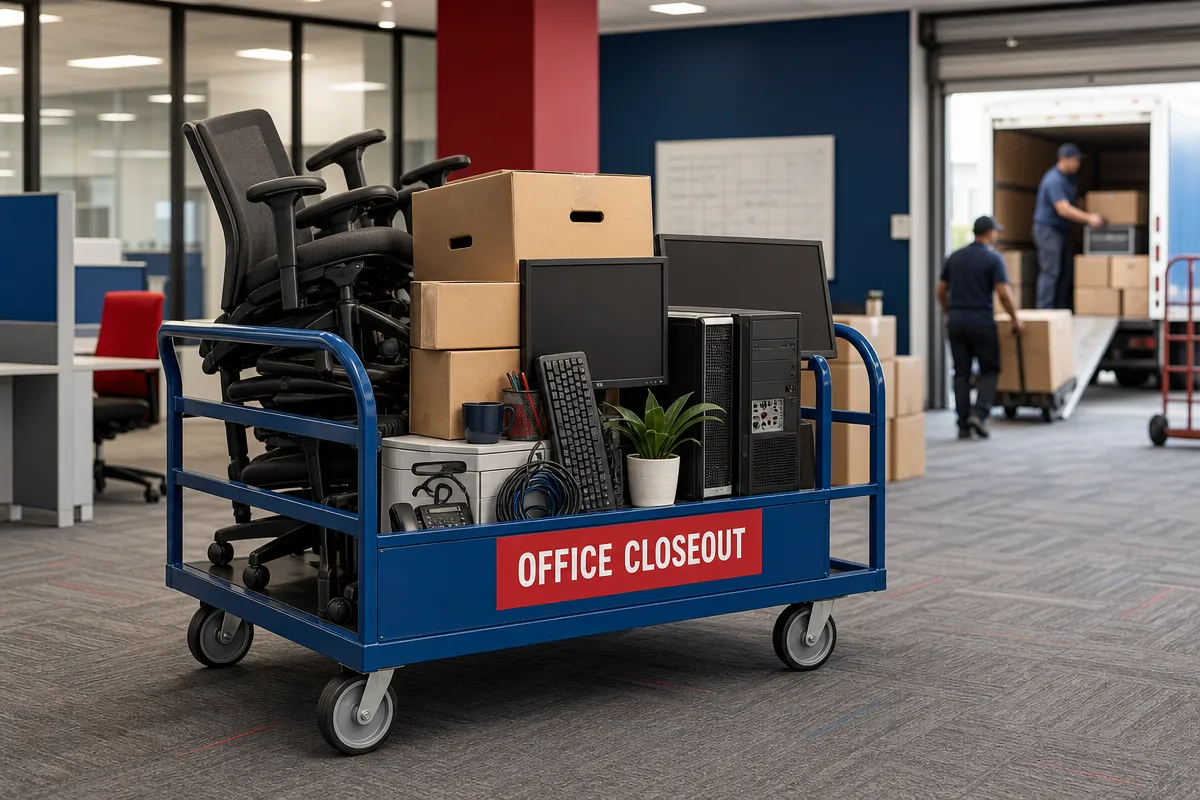
Office liquidation works best when it is planned as a business transition, not a last-minute cleanout. Whether a company is relocating, consolidating, renovating, or closing a location, the process should account for inventory, asset recovery, data security, removal logistics, lease obligations, and final documentation.
Start the closeout with a detailed asset assessment
A successful closeout begins well before the final move-out date. The first step is to identify what the company owns, what must keep operating, and what can be removed, sold, donated, recycled, disposed of, or stored. This prevents rushed decisions as the lease deadline approaches.
Assign one project owner to maintain the master inventory and coordinate decisions. That person should gather input from facilities, IT, finance, department leaders, and anyone responsible for leased or specialty equipment.
The inventory should be practical enough for crews to use and detailed enough for finance, insurance, donation records, chain of custody, and final closeout reporting. Include photos when possible, especially for high-value furniture, specialty items, and assets with unclear condition.
A useful inventory typically captures:
Asset description, manufacturer, model, and serial number when available
Quantity, condition, location, and photographs
Ownership status, including leased, financed, or company-owned items
Intended outcome, such as retained, relocated, sold, donated, recycled, disposed of, or stored
Any special handling needs for electronics, fixtures, signage, or specialty equipment
It is also important to separate daily-use assets from true surplus assets. Furniture and equipment that are still needed for operations should not be mixed with liquidation items. That distinction helps reduce disruption and lowers the risk of removing the wrong property.
Liquidation and decommissioning often overlap, but they are not identical. Liquidation is the financial process of selling or offloading assets, while decommissioning is the physical removal of those assets from the space. Many projects require both, especially when a tenant must vacate a building by a fixed date.
Route Surplus Assets to Reuse, Resale, Donation, Recycling, Disposal, or Storage
Once the inventory is complete, each asset needs a destination. A practical disposition hierarchy starts with reuse, then resale, donation, recycling, disposal, and storage when the final decision is not ready. This approach helps preserve value while keeping the project on schedule.
Reusable assets may be more valuable inside the company than on the market
Transferring workstations, seating, shelving, or equipment to another branch can preserve more value than selling under time pressure. Reuse is especially helpful during phased moves, downsizing projects, and multi-location consolidations.
Storage can also support better decision-making. When a new site is not ready or a company is unsure which assets will be needed later, a warehouse can keep retained or undecided items out of the old space without forcing an immediate sale or disposal decision.
Resale and donation require timing, records, and realistic expectations
Resale works best for clean, complete, recognizable, and commercially useful assets such as conference tables, seating, filing cabinets, shelving, appliances, and selected business equipment. Pricing should account for condition, market demand, disassembly, transportation, storage, and the time available before surrender.
Donation can give usable furniture, supplies, and operating electronics a second life. Companies should confirm acceptance criteria, arrange pickup or delivery, and obtain written acknowledgments. The IRS states that property contributions of $250 or more generally require contemporaneous written acknowledgment, while larger noncash claims may require additional documentation.
RCS coordinates liquidation and disposal as part of commercial closeout projects, helping clients connect asset removal with moving, storage, installation, and downstream disposition planning.
Recycling and disposal should be documented as final pathways
Recycling is appropriate when assets cannot reasonably be reused, sold, or donated. Furniture may need to be separated into material streams, while electronics require special attention. Landfill disposal should be treated as the last resort.
Keep receipts, weight records, disposal tickets, and recycling confirmations where available. These records support internal accountability, sustainability reporting, and the final project file.
Protect Data, People, and Building Operations During Removal
An office closeout must account for risk controls, not just hauling. Electronics, occupied work areas, loading docks, freight elevators, and building rules all affect how the project should be scheduled and executed.
Computers, servers, drives, phones, printers, and networking equipment require a separate chain-of-custody process. Before removal, the company should identify data-bearing equipment, back up required information, address retention requirements, remove devices from identity and endpoint-management systems, and confirm how software licenses will be handled.
Data sanitization should match the sensitivity and condition of each device. Working drives intended for reuse may receive documented software wiping, while failed drives or highly sensitive equipment may require physical destruction. The EPA identifies R2 and e-Stewards as accredited certification standards for electronics recyclers in the United States.
Businesses should request certificates of data destruction, recycling, or asset processing before the work begins. The EPA also advises deleting personal information before donation or recycling and notes that lithium-ion batteries and devices containing them should not be placed in ordinary household garbage or recycling bins.
Regional requirements matter as well. North Carolina bans disposal of covered computer equipment and televisions in landfills and directs businesses toward local programs, registered electronics recyclers, manufacturers, and certified providers. Virginia treats electronics as special waste requiring appropriate management.
Removal logistics should be planned around business continuity. In occupied offices, a phased schedule may remove one department, floor, or asset category at a time while employees continue working. This is especially useful when technology must remain operational until the final business day.
Before crews arrive, confirm work windows, staging zones, elevator reservations, loading dock appointments, truck requirements, security procedures, parking limits, and after-hours access. Commercial buildings commonly require certificates of insurance, vendor registration, named additional insureds, and specific dock or elevator reservations.
Site protection should cover floors, walls, doors, elevators, corners, staging areas, and clear routes to the dock. OSHA requires safe clearances in aisles, doorways, loading docks, and other passageways, and only trained and certified workers may operate forklifts.
Align the Closeout Plan With Lease Requirements and Final Documentation
Asset disposal cannot be separated from lease surrender obligations. Before scheduling removal, review the lease, amendments, building rules, alteration approvals, and landlord correspondence. The space may need to be vacant, broom-clean, free of debris, returned in good condition, or restored to a prior configuration.
Some leases may require removal of partitions, cabling, signage, trade fixtures, specialty installations, or other alterations. Because the exact obligation depends on the lease and landlord instructions, uncertain items should be identified early and resolved in writing.
Late discoveries can create extra labor, disposal, repair, and holdover costs. A room-by-room closeout checklist helps reduce that risk and gives the project owner a clear way to verify progress.
The checklist should cover offices, conference rooms, kitchens, storage rooms, closets, server rooms, loading areas, and concealed or abandoned equipment. Each area should be checked for remaining personal property, residual materials, floor and wall condition, and any building property that must be returned.
Final documentation is just as important as the physical removal. A well-organized project file should show what happened to each material category and preserve records that may be needed later.
Useful closeout documents include:
Final inventory showing retained, relocated, stored, sold, donated, recycled, and disposed assets
Resale records, donation acknowledgments, recycling receipts, and disposal tickets
Data-destruction certificates and electronics processing records
Photographs of completed rooms, loading areas, and restored spaces
Landlord or property-manager confirmations where available
Invoices, work orders, and any final closeout report
Schedule an internal inspection before the landlord walkthrough. This gives the team time to correct missed items, verify that keys and access cards are ready to return, and confirm that the premises match the agreed closeout standard.
When liquidation overlaps with a move, consolidation, renovation, or installation, destination codes and load sequencing become critical. Assets going to a new office, warehouse, buyer, nonprofit, recycler, or disposal facility should be labeled clearly so retained property does not end up in the wrong channel.
If your business is preparing for an office liquidation in Virginia or North Carolina, RCS can help coordinate the moving, warehousing, installation, liquidation, and disposal pieces of the closeout. Request a Quote through our contact page, call us today at (804) 358-4035, or email us at contact@rcsmoving.com.