.svg)


.svg)
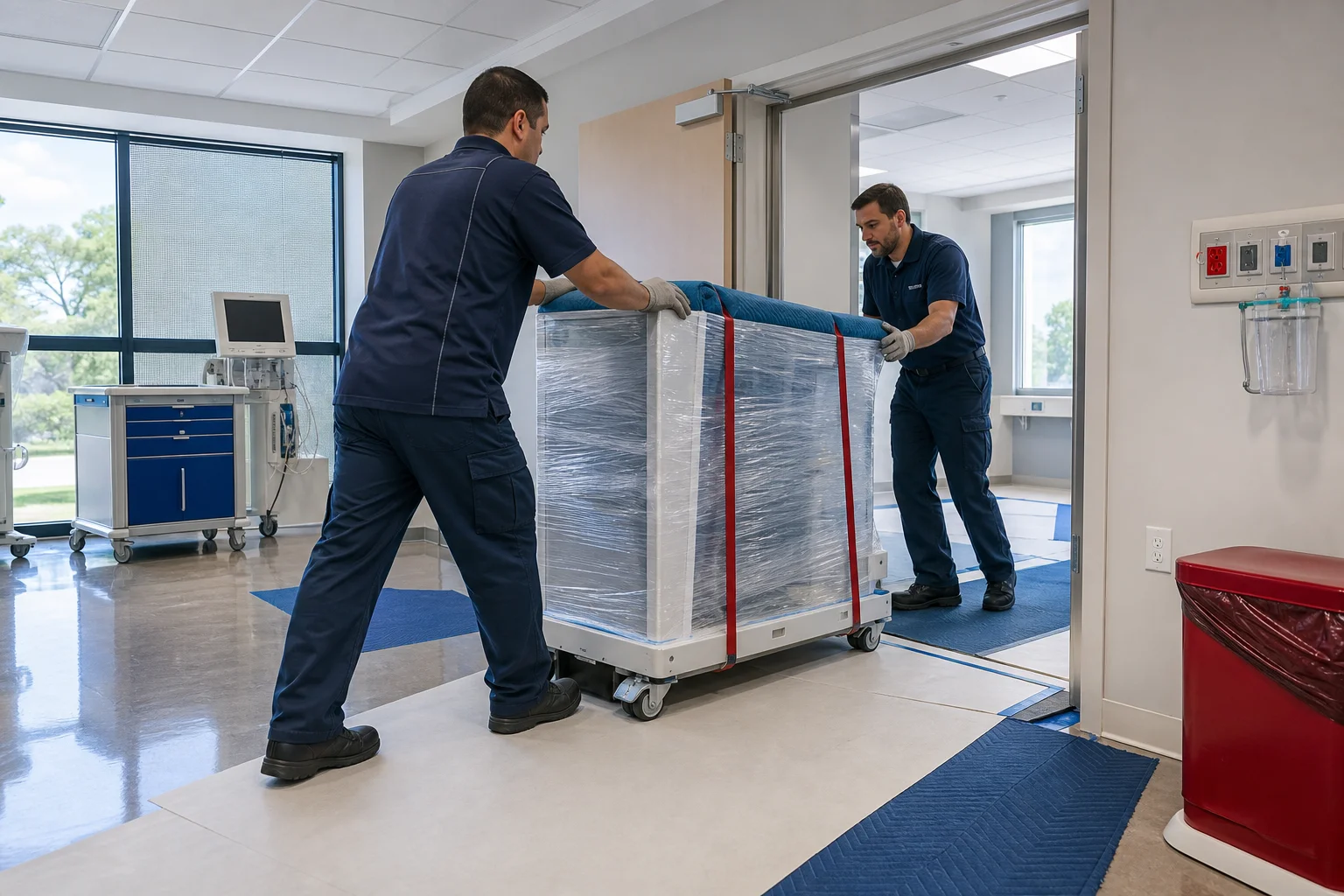
Medical equipment installation is rarely just a delivery appointment. In a hospital, imaging center, clinic, lab, or other healthcare setting, the physical move has to fit around room readiness, vendor requirements, patient-care schedules, infection-control rules, utilities, IT, and final clinical approval.
RCS Commercial Moving & Warehousing supports healthcare and commercial organizations across Virginia and North Carolina, including Charlotte, Raleigh, Richmond, and surrounding service areas, with the nonclinical moving, storage, logistics, installation, and coordination work that helps these projects stay organized.
If you have questions about planning a healthcare equipment move or installation project, reach out to our team through our Contact Us Today page.
A clear scope of work prevents confusion during equipment installation
A successful installation starts before a crate arrives at the dock. The project team should define the scope of work in writing, then assign responsibility for every handoff. This is especially important when multiple parties are involved, including the facility, equipment vendor, OEM technician, biomedical engineering team, construction manager, IT group, and moving partner.
The most useful planning document is a responsibility matrix. It should identify who authorizes shutdown, disconnects equipment, packs components, receives shipments, stores assets, transports them, reconnects utilities, performs calibration, verifies software, completes acceptance testing, and authorizes return to service.
This distinction matters because contractors and companies do not all perform the same work. Some handle specialized technical connections. Others manage transportation, receiving, staging, placement, and coordination. The project scope should make those boundaries clear.
Room-by-room inventory is the foundation for controlled installation work
Before packing, transporting, or staging assets, the team should create a room-by-room inventory. That inventory should capture enough detail to support planning, handling, destination placement, and closeout documentation.
Useful records include asset ID, manufacturer, model, serial number, source room, destination room, dimensions, weight, center of gravity, condition photographs, accessories, cables, probes, software dependencies, utility needs, calibration status, clinical criticality, and responsible owner.
RCS can generally perform or coordinate the nonclinical physical scope: site walks, inventories, packing, loading, protective wrapping, transportation, warehouse receiving, inspection, labeling, staging, cross-docking, internal movement, placement, basic assembly, packaging removal, and project reporting. Technical or regulated work should remain with the appropriate party.
That means hardwired electrical connections, medical gases, chilled water, cryogenic systems, radiation-producing equipment, MRI magnets, specialized anchors, calibration, software configuration, validated laboratory systems, and clinical acceptance testing should be assigned to licensed trades, OEM technicians, biomedical engineering, clinical engineering, or other qualified specialists.
Hospital equipment installation depends on full route and room readiness
Site readiness includes more than confirming that the destination room is empty. The route from the origin room to the vehicle, and from the receiving dock to the final destination, must be surveyed. A good route plan identifies the physical limitations that can delay a delivery or create risk during handling.
Planning factors include doorways, corridors, elevators, ramps, loading docks, turning radii, ceiling heights, thresholds, floor-load limits, pinch points, overhead obstructions, construction openings, and finished surfaces. These details are especially important when equipment is large, fragile, heavy, or difficult to maneuver.
The destination room should also be confirmed ready before delivery. Readiness checks may include power, emergency power, grounding, network connections, medical gases, compressed air, water, drainage, chilled water, HVAC, exhaust, shielding, fire protection, room clearances, floor capacity, and infection-control release.
RCS can document readiness through site walks, floor-by-floor logistics maps, asset inventories, delivery schedules, installation sequencing, and issue tracking. However, a moving partner should not independently approve clinical readiness or override an OEM requirement. The hospital’s facilities, clinical engineering, IT, infection-prevention, radiology, laboratory, and department leadership teams should validate that the room can support the intended use.
Imaging and MRI installation require stricter technical coordination
Imaging projects often involve additional planning because the equipment, room, and technical requirements are more complex. The MR Project Implementation Guide reflects how site readiness, room preparation, and coordination affect MRI installation planning.
For these projects, the moving scope should be separated from magnet-related, utility, shielding, software, calibration, and clinical acceptance responsibilities. RCS can support the logistics side, including receiving, staging, transport, placement support, and coordination. OEM technicians, specialized trades, qualified riggers, biomedical engineering, and clinical engineering should handle the technical work assigned to them.
Receiving, staging, and cross-docking keep equipment moving on schedule
Receiving is a controlled process, not just unloading. The project team should schedule dock access, coordinate vehicle arrivals, follow facility security procedures, and use a planned unloading method. At the dock, the receiving team should verify each shipment against the purchase order, bill of lading, asset manifest, crate or seal numbers, serial numbers, accessories, packaging condition, and any environmental-monitoring records.
Inspection should happen before the equipment is accepted or energized. Packaging and equipment surfaces should be checked against origin photographs when available. Loose or missing parts, visible damage, and packaging exceptions should be photographed and documented. Suspected shock, tilt, temperature, humidity, contamination, or packaging excursions should be held for OEM or biomedical review.
Warehouse staging is often useful when construction is incomplete, rooms are released in phases, or departments must remain operational during the project. It gives the team a way to separate delivery dates from installation dates while maintaining visibility into each asset.
Assets can be organized by several practical categories before they move to the final room. The goal is to make retrieval predictable and prevent the wrong item from appearing at the wrong phase of the project.
Department or destination room
Installation phase or construction release date
Security level or access restriction
Temperature requirement or cleanliness requirement
Fragility, handling method, or hazardous-material restriction
Data sensitivity or responsible department owner
Scheduled retrieval date
Cross-docking is a good fit when equipment arrives from an OEM or distributor and should move through receiving directly into a planned installation phase rather than remain in longer-term storage. In that model, shipments are received, inspected, labeled, consolidated, and delivered in alignment with the move schedule.
Material-handling controls must match the load and the facility environment. Heavy, fragile, or high-value equipment may require moving equipment, trained labor, structural review, a qualified rigging contractor, crane services, or OEM supervision. The moving plan should identify those needs before the delivery truck arrives.
Sequencing work in active healthcare environments protects operations
In active healthcare facilities, installation sequencing must account for patient care, clinical downtime, infection-control requirements, elevator availability, construction releases, vendor attendance, and equipment criticality. The sequence is not just a logistics preference. It determines whether the work can happen without disrupting essential hospital functions.
Lower-risk administrative, clinic, storage, or noncritical areas may be completed first. Emergency, intensive-care, operating-room, pharmacy, sterile-processing, laboratory, and imaging areas typically require more detailed readiness checks, fallback planning, and approval before work begins.
A workable sequence usually begins with scope confirmation and responsibility assignment. The project team then surveys routes and rooms, approves the method of procedure, verifies destination readiness, receives or stages equipment, establishes protected routes, delivers by room or department, positions and levels equipment, coordinates technical connections, completes OEM or biomedical testing, finishes room setup, conducts a walkthrough, and obtains documented release.
In occupied facilities, mover traffic should be separated from patient, staff, clean-supply, dirty-service, ambulance, and emergency routes whenever possible. Work may be scheduled during nights, weekends, low-volume periods, or controlled shutdown windows. The hospital must determine when a clinical service can be interrupted.
Infection-control planning should be built into the schedule
Infection-control planning is part of site readiness and sequencing. The project team should plan protected routes, barriers, daily cleaning, traffic diversion, and work-zone controls before movement begins. The Clinical Imaging Board guidance also reflects the importance of coordination across equipment planning, installation, and healthcare operations.
These controls are especially important near immunocompromised patients, operating rooms, protective environments, isolation rooms, laboratories, or sterile-storage areas. A mover can help execute the physical logistics plan, but infection-prevention and facility leadership should define the applicable controls and approvals.
A command structure should track room readiness, vehicle status, equipment exceptions, utility outages, IT dependencies, clinical impacts, and go or no-go decisions. RCS can maintain delivery schedules, placement logs, issue trackers, and communication among parties. Clinical leaders and technical authorities should retain authority over patient-safety and service-reopening decisions.
Placement, safety, and vendor coordination must match the equipment risk
Once equipment reaches the destination room, placement still needs to be managed carefully. The team should compare the destination with the approved layout, confirm access clearances, protect finished surfaces, and position the asset in the planned location. Depending on the equipment, placement may also include leveling, basic assembly, removal of packaging, and documentation of condition.
Placement should not be confused with technical installation. A moving crew may physically place an asset in the correct room and location, but final utility connection, calibration, software configuration, validation, and clinical acceptance belong to the assigned technical parties.
This is where vendor coordination becomes critical. OEM or vendor representatives may need to be present before equipment is unpacked, positioned, opened, energized, or tested. Biomedical engineering, clinical engineering, facilities, IT, radiation safety, or licensed trades may also need to be on-site depending on the asset.
A safe installation plan should identify the people, approvals, and dependencies required before each step. It should also state what happens if the room is not ready, the vendor is delayed, the equipment arrives damaged, a utility is incomplete, or an access route is blocked.
For projects involving equipment installation in Charlotte, NC, RCS is positioned to support local receiving, warehousing, staging, transport, placement, and coordination from its Charlotte-area presence. Specialized technical work should still be assigned to OEMs, licensed trades, qualified riggers, biomedical engineering, clinical engineering, infection prevention, and other technical authorities as appropriate.
When imaging equipment is part of the project, vendor coordination can be even more important. A separate MR implementation guide emphasizes site planning and readiness steps that should be addressed before MRI-related work proceeds.
Closeout documentation separates physical completion from clinical release
The final walkthrough should involve the hospital project manager, department representative, moving lead, OEM or vendor representative, biomedical or clinical engineering, facilities, IT, and any other responsible trades. The group should compare the installed condition against the approved room layout, equipment manifest, delivery records, and punch list.
Closeout should document what was delivered, where it was placed, what exceptions remain, and which party is responsible for the next step. This record helps prevent confusion between a move that is physically complete and equipment that is ready for patient care.
Closeout documentation may include several types of project records. The exact package should match the equipment, facility requirements, and responsibilities assigned in the original scope.
Proof of delivery and asset reconciliation
Serial-number verification and destination-room confirmation
Condition reports and photographs
Shock, tilt, temperature, or staging records when applicable
Placement and leveling records
Damage reports or unresolved exception logs
Packaging-removal confirmation
Utility verification by the responsible party
OEM service reports, calibration records, or validation records
Software, network, cleaning, or decontamination status where applicable
The hospital should clearly distinguish physical completion from clinical release. RCS may complete delivery, placement, room setup, and documentation for its moving scope. The OEM, biomedical team, clinical engineer, radiation-safety officer, IT group, or licensed trade should complete the technical testing and approval assigned to them.
Equipment should remain unavailable for patient care until the authorized clinical or technical owner signs the return-to-service approval. Infection-control closeout should also be completed before the space is used, including removal of barriers only after cleaning, restoration of appropriate ventilation or pressure conditions, debris disposal through approved routes, and confirmation that equipment and surrounding surfaces meet facility procedures.
Medical equipment installation works best when logistics, site readiness, vendor coordination, and clinical authority are clearly separated but tightly coordinated. If your organization needs help with healthcare equipment receiving, warehousing, staging, transport, placement, or project coordination, Get a Quote from RCS Commercial Moving & Warehousing, Call us today at (804) 358-4035, or Email us at contact@rcsmoving.com.