.svg)


.svg)
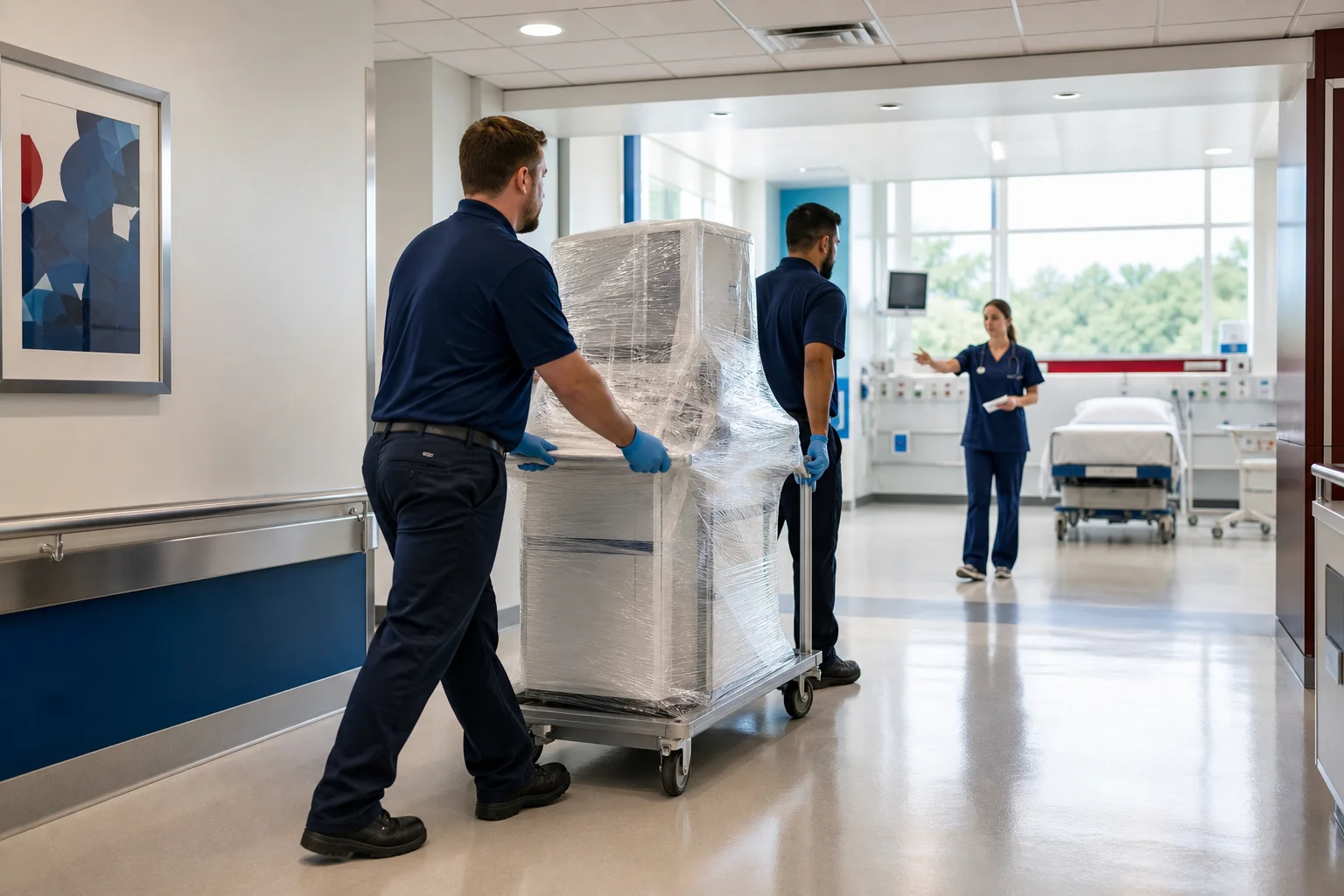
A healthcare facility relocation is not simply a move from one building to another. It is a controlled operational transition where patient care, clinical workflows, equipment readiness, data access, infection prevention, and staff communication all have to line up at the right time.
How to assess operational risk and build relocation governance before moving day
Healthcare relocation planning should start with governance, not packing. A strong relocation structure gives every department a way to identify risk, make decisions, escalate problems, and confirm readiness before patients, staff, equipment, supplies, or records begin moving.
The relocation committee should include executive leadership, clinical department heads, nursing, infection prevention, pharmacy, laboratory leadership, radiology, biomedical engineering, IT, facilities, security, environmental services, supply chain, human resources, communications, vendors, and the moving partner. Research on healthcare moves recommends regular meetings before, during, and after relocation, along with designated substitutes and unit-level champions who coordinate local activity and communicate decisions.
The first major task is to map dependencies and failure points. This should include emergency care, surgery, intensive care, inpatient units, pharmacy, sterile processing, laboratory testing, imaging, blood products, medical gases, utilities, elevators, fire systems, access control, telecommunications, electronic health records, medication administration, specimen handling, waste, laundry, food service, ambulance routes, and external referral pathways.
Facility readiness should be verified before equipment or patients move. Teams should test and document lighting, utilities, power outlets, data connections, medical gases, HVAC, temperature controls, fire protection, signage, elevators, security systems, nurse-call systems, emergency power, refrigeration, freezers, and clean or dirty flow separation.
At this stage, RCS can support readiness through site walks, asset inventories, receiving and staging plans, floor-by-floor logistics maps, installation sequencing, delivery scheduling, and issue tracking. Clinical validation, biomedical approvals, pharmacy controls, radiation safety, and licensed clinical decisions should remain with the qualified specialists responsible for those areas.
How to build a phased relocation timeline and department-by-department move plan
A safe healthcare facility relocation needs a phased timeline that reflects clinical risk. The main phases should include planning, preparation, move execution, reopening, and stabilization. Critical-care moves may require long lead times, while individual imaging, laboratory, administrative, or support-service moves may follow shorter schedules depending on construction, equipment, regulatory, and vendor requirements.
Clinical priority should drive sequencing. Administrative offices, low-risk clinics, noncritical storage, and services that can operate remotely may move first. High-dependency units, emergency services, operating rooms, intensive care, pharmacy, sterile processing, laboratories, and imaging generally require more preparation, fallback capacity, and validation before reopening.
Each department should have its own move plan. The value of this document is practical: it turns a large healthcare move into smaller, testable workflows. It should define what is moving, who is responsible, how items travel, when the department is considered ready, and what happens if a dependency fails.
Scope of rooms, equipment, furniture, supplies, records, and consumables
Move, replace, dispose, or store decisions for each asset
Dependencies on utilities, IT, vendors, construction, cleaning, and clinical validation
Packing, labeling, routing, and transport requirements
Temporary operating locations and backup capacity
Go/no-go criteria, escalation contacts, and move-day schedules
Reconciliation checklists for rooms, equipment, supplies, and records
Mock moves and simulations are especially valuable for patient routes, elevator capacity, medication delivery, meals, communications, equipment handoffs, electronic-record workflows, emergency response, and receiving-room readiness. One intensive-care relocation used 18 months of planning, multiple simulations, dual staffing in old and new units, and transferred 26 critically ill patients in 7.5 hours without deterioration en route.
How to pack, transport, install, and calibrate medical equipment safely
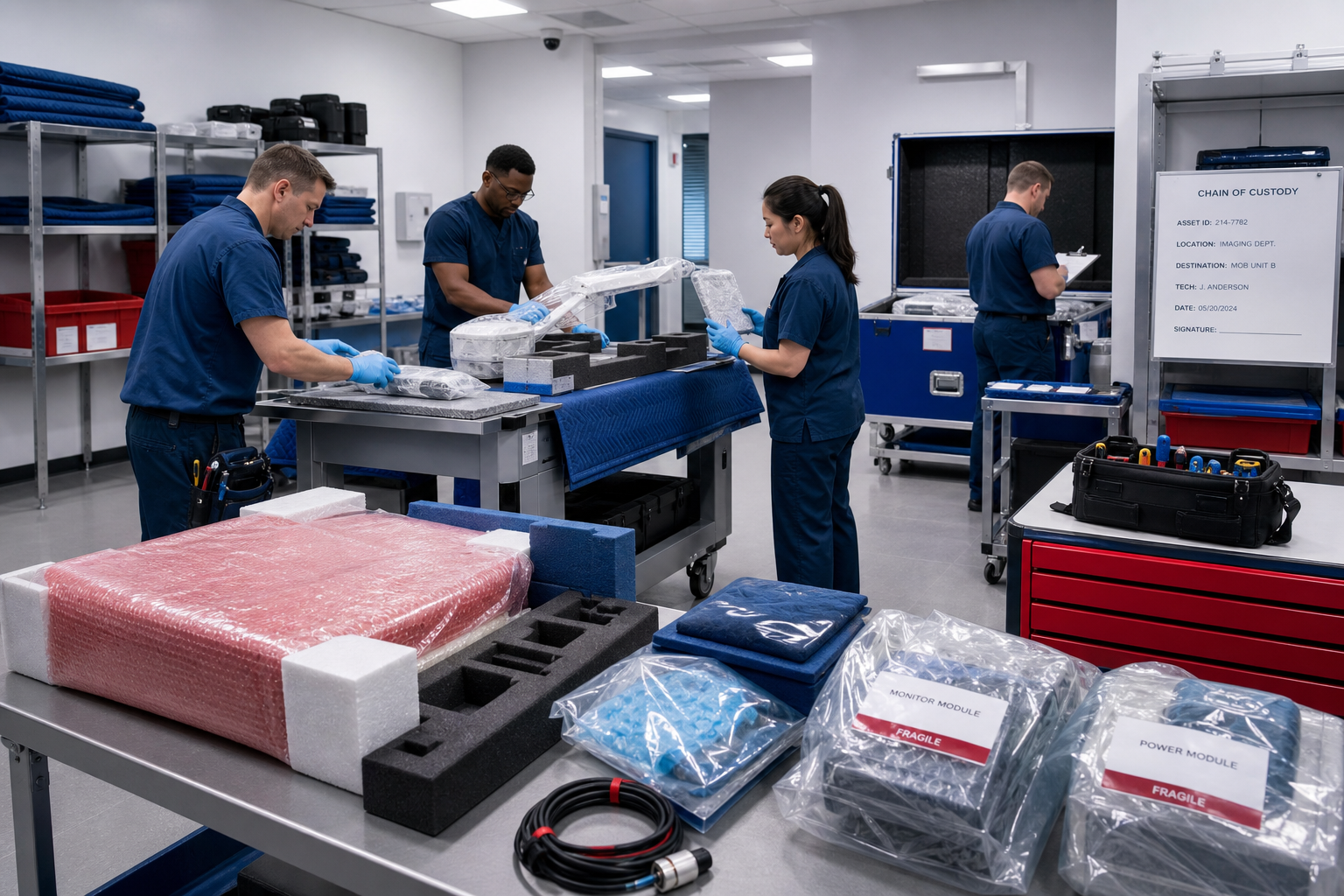
Medical equipment should never be treated like ordinary office furniture. Every device has its own handling needs, utility dependencies, accessories, calibration status, and release requirements. A complete asset inventory is the foundation for safe medical relocation.
Each record should include asset tag, serial number, manufacturer, model, current location, destination room, ownership, condition, photographs, accessories, configuration, calibration status, warranty information, data-storage status, and decontamination status. The inventory should also identify whether the asset will be moved, replaced, decommissioned, sent to temporary storage, or delivered directly from a vendor.
Packing methods should match the device. Plans may require custom crating, shock and vibration protection, anti-static materials, moisture protection, orientation controls, climate-controlled transport, locked components, removable-part labeling, and environmental monitoring. Chain-of-custody documentation should show when the equipment was released, who handled it, how it traveled, where it was staged, and when it arrived.
Some equipment requires deinstallation by qualified technicians or OEM-authorized personnel. Devices connected to medical gases, water, drains, high voltage, radiation, cryogens, specialized anchors, or sensitive mechanical assemblies should be reviewed before any disassembly begins.
Imaging equipment requires especially careful coordination. MRI relocation may involve magnet ramp-down or transport planning, cryogen management, rigging, shielding, and room-readiness checks. CT, radiography, fluoroscopy, ultrasound, and nuclear-medicine systems each have their own requirements for disassembly, bracing, radiation, alignment, installation, and acceptance.
Placement in the destination room is not the final step. Reinstallation should include assembly, utility connection, software and network configuration, safety checks, preventive-maintenance review, calibration, performance testing, image-quality testing where applicable, radiation-safety surveys, and clinical-user acceptance. Equipment should remain out of patient service until the appropriate authorized authority releases it.
How to protect patient records, HIPAA compliance, and data integrity during the move
Patient records, electronic media, and devices that contain protected health information need controlled handling throughout a healthcare facility relocation. The move plan should account for paper charts, archived records, portable media, computers, servers, medication systems, diagnostic equipment with data storage, and any device tied to electronic health record workflows.
The most important principle is accountability. Sensitive materials should be included in department-level manifests, assigned to approved routes, and moved only through documented handoffs. Labels should support identification and routing without exposing unnecessary patient information. Access should be limited to the staff, vendors, and healthcare movers authorized for that move phase. Transport documentation should connect the source location, destination location, responsible department, release contact, receiving contact, and delivery status. If records or devices need temporary storage, storage plans should classify them by security, data sensitivity, required retrieval date, and destination readiness. This prevents sensitive materials from being staged casually or moved ahead of the systems needed to secure them.
IT readiness is equally important. Before a department reopens, the receiving site should have confirmed data connections, telecommunications, network access, electronic health record access, device connectivity, and downtime procedures. Workflows involving medication administration, specimen handling, patient tracking, imaging, laboratory reporting, and communications should be tested before clinical activity resumes. If systems are not ready, the department should follow the go/no-go criteria defined in its move plan. A physical move that outpaces IT validation can create operational gaps, even if rooms, furniture, and equipment are in place. Data integrity should be treated as part of patient safety, not as a separate technical task.
How to maintain infection control, sanitation, and clean move paths throughout relocation
Infection prevention should be built into the relocation plan from the earliest site assessment. Before construction, renovation, demolition, repair, or other work that may generate dust or water aerosols, CDC guidance supports an infection-control risk assessment, often called an ICRA.
The assessment should consider susceptible patients, nearby patient-care areas, supply storage, spaces above and below the work area, airflow, barriers, dust, moisture, traffic, and construction-related fungal-spore risks. These conditions affect move timing, routes, cleaning requirements, and whether adjacent areas can remain occupied.
Relocation teams should define clean and dirty routes before work begins. Patient traffic and mover traffic should be separated where possible. Elevator use, corridor access, air intakes, air returns, supply staging, waste movement, and construction-adjacent paths should be controlled to reduce contamination risk.
CDC recommendations include impermeable barriers, sealed return-air vents where appropriate, dust-control measures, diverted pedestrian traffic, and relocation of patients near work zones when conditions require it. These controls should be visible in the move plan, not handled informally on move day.
Equipment and supplies also need sanitation checkpoints. Interior Health’s relocation procedure identifies noncritical equipment, including imaging equipment, electronic monitoring equipment, and commode chairs, as requiring cleaning and disinfection before movement and before installation at the receiving facility.
A practical move manifest can include source-area release, protected loading, vehicle and cart condition, receiving-area acceptance, destination cleaning, and clinical release. Movers should receive site-specific orientation covering hand hygiene, personal protective equipment, restricted areas, isolation precautions, spill response, sharps and hazardous-material boundaries, and procedures for stopping work when contamination or an unsafe route is identified.
How to coordinate storage, cross-docking, communications, and reopening after the move
Temporary storage and cross-docking can reduce congestion when departments move in waves, rooms are not ready, construction dates shift, or furniture and equipment must be staged before installation. Storage plans should classify assets by security, temperature, cleanliness, fragility, hazardous-material restrictions, data sensitivity, and required retrieval date. Cross-docking is useful when vendor shipments, replacement equipment, supplies, and relocated assets need to be received, inspected, labeled, consolidated, and delivered directly into a move phase without extended storage. RCS reports more than 250,000 square feet of warehouse capacity, more than 60 trucks, and more than 100 movers, installers, and drivers on its hospital-services materials, which can support staging and phased delivery when coordinated with the facility’s readiness plan.
Communication should be role-specific. Staff need schedules, routes, room assignments, training, contact lists, downtime procedures, parking instructions, access rules, and escalation paths. Vendors need delivery windows, loading instructions, credentialing, site constraints, dependencies, and acceptance requirements. Patients and families need advance notice of temporary closures, changed entrances, appointment impacts, accessible routes, phone numbers, alternative locations, and reopening dates. Community partners also need updates. EMS, referral partners, pharmacies, laboratories, transport providers, public agencies, and community organizations should receive clear information about service availability and emergency pathways.
On move day, a command center should maintain a live status board covering patients, departments, vehicles, equipment, rooms, utilities, IT systems, incidents, delays, and go/no-go decisions. Healthcare relocation research recommends sharing performance metrics, keeping units aware of changes, using unit champions, providing temporary signage, and maintaining alternative areas and extra resources during transition. After reopening, the facility should use a stabilization period with daily huddles, rapid issue resolution, asset reconciliation, equipment-defect tracking, infection-control review, supply monitoring, patient-flow observation, and after-action lessons. The goal is to correct operational problems before they become lasting disruptions.
If your organization is planning a healthcare facility relocation in Virginia, North Carolina, Washington, DC, or nearby service areas, RCS Commercial Moving & Warehousing can help coordinate commercial moving, storage, logistics, installation services, and phased project support. Get a Quote or call us today at (804) 358-4035.