


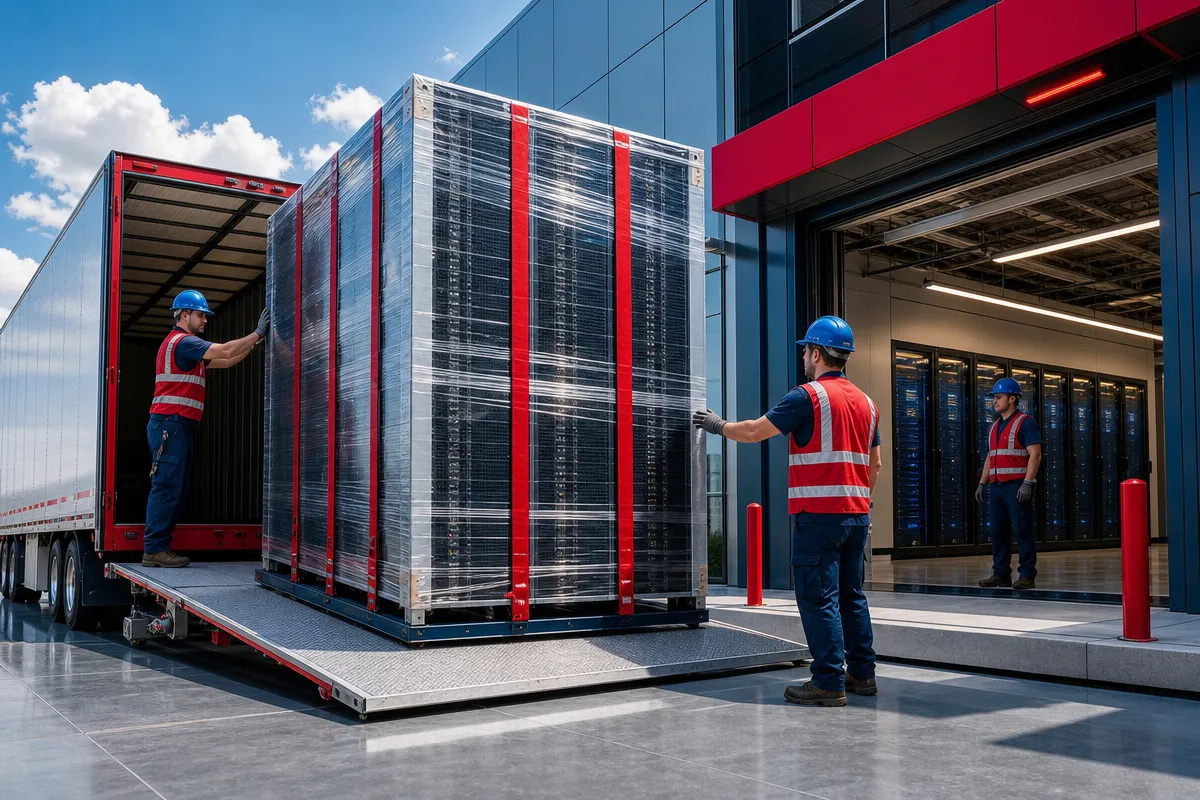
Delivery sequencing is one of the most important controls in an AI data center project because power, cooling, structural, and IT infrastructure deliveries all depend on one another. A transformer, switchgear lineup, cooling unit, rack, or GPU shipment may be on time by the supplier’s standard, yet still be too early, too late, or out of order for the construction schedule.
AI Data Center Delivery Sequencing Should Follow the Installation Path
AI data center construction depends on several delivery streams moving toward the same milestones. Electrical equipment, cooling systems, structural materials, and IT infrastructure such as racks, networking equipment, and GPUs each have different lead times, transport requirements, suppliers, and handling needs. The shared goal is not simply arrival, but installation, energization, testing, and commissioning.
The strongest sequence starts with the installation path rather than supplier shipping dates. Power distribution equipment usually has to be placed, connected, and tested before IT hardware can be energized. Cooling equipment, controls, piping, and mechanical systems also need to reach the required level of completion before high-density IT loads can operate.
That means a project team should translate the construction schedule into delivery release requirements. These details help prevent the common mistake of treating freight arrival as the finish line. In practice, the delivery is only successful when the site is ready to receive it and the crew is ready to act on it.
Each release should connect freight to field readiness
A useful release package identifies the equipment, installation area, required-on-site date, delivery window, receiving method, lifting plan, and responsible crew. It should also confirm the access route, receiving team, inspection process, staging location, and final destination.
Early delivery can be just as disruptive as late delivery. Equipment that arrives before the room or laydown area is ready can create congestion, extra handling, weather exposure, security concerns, and damage risk. Late delivery can affect inspections, installation sequences, energization, and commissioning milestones, especially when interdependent systems are waiting on one missing component.
Room Readiness and Crew Availability Should Control Equipment Release
A release decision should be tied to measurable room-readiness gates. This keeps the project from dispatching equipment simply because it is manufactured or sitting at a supplier dock. For sensitive or high-value equipment, the room, access path, storage conditions, and labor plan matter as much as the delivery date.
Room readiness can include weather-tight construction, completed floors, housekeeping pads, adequate clearance, lighting, fire protection, available power or environmental controls, and authorization for the proper trade to work in the space. Sensitive equipment may also require clean, climate-controlled receiving or storage conditions before installation.
Crew availability is another critical dependency. A transformer, switchgear lineup, chiller, generator, rack, or cooling-distribution unit should not be dispatched unless the installation crew, rigging team, commissioning personnel, tools, and required handling equipment are aligned with the delivery window.
Site logistics must be scheduled like a construction activity
Delivery appointments should reserve more than a date and time. Data center projects often require coordinated dock doors, internal travel paths, cranes, forklifts, escorts, final placement areas, and security procedures. Oversized electrical and mechanical equipment may require dedicated laydown space, wide access, heavy floor loading, or drive-in and dock capabilities.
Security and access controls should be built into the appointment process. These projects involve high-value electrical, mechanical, networking, and computing equipment, so carriers and drivers may need advance credentials, vehicle information, approved routes, escort arrangements, seal checks, and documented handoff. The delivery appointment should identify the approved gate, receiving team, security procedure, staging location, and final destination.
For project teams in Virginia and North Carolina, this is where a coordinated logistics partner can help connect warehouse release, site access, and installation timing. RCS supports commercial storage, cross-docking, and logistics workflows that help equipment move when the project is ready, not simply when freight becomes available.
Warehouse Staging and Cross-Docking Create a Controlled Buffer
A forward staging warehouse gives the project team a controlled buffer between suppliers and the construction site. Instead of sending every inbound shipment directly to the project, the warehouse can receive materials early, inspect them, record inventory, protect them, consolidate loads, and release equipment according to actual site requirements.
This is especially useful when site space is constrained or equipment arrives months before installation. Effective staging is more than storage. It organizes equipment by building, room, system, installation phase, delivery sequence, and required handling method.
The operating model should be simple: receive, secure, sequence, and deliver the correct items to the correct location in the condition and timetable required by the build schedule. Cross-docking and consolidation can reduce unnecessary dwell time and handling by bringing shipments from multiple vendors into one facility, checking them against purchase orders and packing lists, grouping them into project-specific loads, and transferring them to outbound transportation when the room and crew are ready.
Controlled release should replace informal delivery calls
A controlled release process works best when it is documented. Informal calls can miss critical details, especially when many suppliers, contractors, and site teams are involved. A release package should give the warehouse, carrier, and receiving team the same understanding of what is moving and why.
The release process should identify the approved delivery date, window, equipment serial numbers, crate and load details, destination room, installation sequence, lift plan, carrier instructions, security requirements, and named contacts. This lets the logistics provider pick, inspect, configure, and load equipment in the order requested by the construction manager or general contractor.
Environmental and inventory controls are also important. High-value equipment should remain identifiable and protected from receipt through final placement. Serial-number tracking, cycle counts, photo records, seal verification, condition reports, and chain-of-custody signatures create evidence that the right equipment arrived, remained protected, and was released under the correct authorization.
In one documented large data center case, equipment was consolidated from nine vendors and 13 infrastructure categories at a facility within 10 miles of the project, with temperature and humidity monitoring, category-specific procedures, and proof-of-delivery validation used to support delivery control.
Lead Times, Freight Status, and Exceptions Must Stay Linked to the Master Schedule
Supplier lead times should be treated as schedule inputs, not procurement notes. Reported examples include transformer lead times of up to three years, generator lead times exceeding one year, cooling-system lead times of 12 to 18 months, optical-fiber lead times of six to eight months, and structural-steel lead times of about one year, reflecting how stretched data center supply chains remain.
The master schedule should connect each major item to a chain of dates: design release, approved submittal, purchase order, production start, factory testing, readiness for shipment, transit, inspection, warehouse receipt, staging completion, site delivery, installation, testing, energization, and commissioning.
Float should be measured against the milestone the item enables. For one system, that may be mechanical completion. For another, it may be electrical turnover, first power, integrated systems testing, or commercial operation. This approach makes the schedule impact of each delivery visible before a delay reaches the critical path.
Late, damaged, or out-of-order deliveries need a defined escalation path
Freight tracking should update schedule forecasts continuously. Useful milestones include manufacturing completion, pickup, departure, clearance, arrival at the staging warehouse, inspection status, release authorization, appointment confirmation, site arrival, unloading, and proof of delivery. A change in estimated arrival should trigger review of downstream labor, crane, dock, room-readiness, and commissioning activities.
When an item is late, the team should identify whether it is on the critical path, determine the earliest credible revised arrival, and assess recovery options. These may include expedited transport, alternate routing, supplier recovery plans, substitute equipment, temporary systems, partial shipment, or resequencing of unaffected work.
Out-of-order arrivals should not automatically go to the site. They can be held at the staging warehouse, reclassified against another installation zone, or released only after the contractor confirms that storage, access, and labor are available. Damage controls should begin at receipt with packaging inspection, photos, serial-number verification, quarantine of suspect units, and notification under the agreed claims procedure.
Because AI data center projects involve interdependent streams, delays in one category can affect the rest of the build. Industry reporting has described AI buildout supply chains as a major chokepoint, which makes schedule-linked logistics discipline essential.
A practical operating model uses one integrated logistics register tied to the master schedule. The register should include equipment category, supplier, quantity, serial numbers, dimensions and weight, environmental requirements, room and system assignment, installation predecessor, crew, crane or dock requirement, warehouse location, freight milestone, planned delivery window, status, and risk owner.
If your AI data center or commercial project needs coordinated warehouse storage, cross-docking, logistics, or installation support, RCS Commercial Moving & Warehousing can help plan an installation-ready flow. Get a Quote or call us today at (804) 358-4035.