


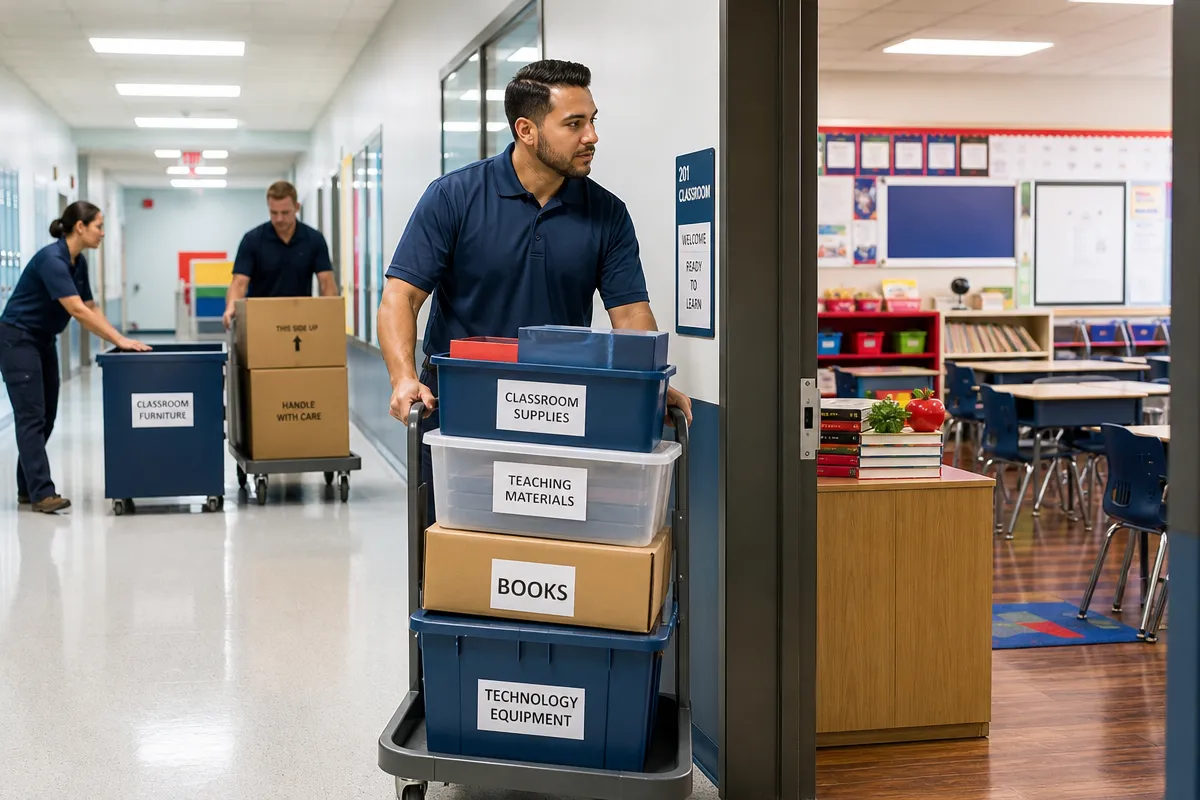
Hiring school moving services is different from hiring a general mover for a standard office relocation. A school move has to protect instructional time, student records, technology, classroom materials, library collections, laboratory equipment, and the deadline for reopening spaces to faculty and students.
A school moving company should start with a detailed site survey, not a generic estimate
A reliable school moving company should begin by walking the facility and understanding how the school actually operates. A generic estimate cannot account for the differences between classrooms, laboratories, libraries, administrative offices, loading docks, elevators, security procedures, parking restrictions, and routes between buildings.
The site survey should help the mover understand where materials are now, where they are going, and what has to happen before each space is ready for use. This is especially important when the move is tied to renovations, consolidations, additions, or a strict opening date.
Administrators should also ask whether the mover assigns a dedicated project manager. That person should coordinate with district leaders, facilities teams, IT personnel, contractors, teachers, department heads, and other stakeholders. A written plan should identify responsibilities, delivery windows, room-by-room sequencing, access needs, contingencies, and deadlines for making each space operational.
A strong proposal should show exactly how the school will be tracked
Inventory is one of the clearest signs that a mover understands school relocation. The proposal should explain how items will be identified, labeled, moved, stored if needed, and placed in the correct destination. Useful inventory fields include the originating room, destination room, asset description, quantity, condition, special handling requirements, installation needs, and storage status.
Tracking systems may include color-coded labels, barcodes, room codes, or equivalent methods. The goal is simple: desks, records, technology, teaching supplies, and equipment should arrive in the correct rooms, in the correct sequence, with as little confusion as possible.
The academic calendar should drive the school relocation schedule
School moves are schedule-sensitive because the deadline is not flexible in the way many commercial projects are. Teachers need access before students return. IT systems need to be active. Furniture must be assembled. Classrooms, offices, and shared spaces need to be cleaned, inspected, and ready.
Summer is often preferred for large school relocations because schools typically have an eight-to-twelve-week period of reduced activity, while winter break often provides only two to four weeks, according to school relocation planned around the timetable. Even so, summer moves still require early preparation because the schedule may depend on construction completion, cleaning, IT activation, furniture installation, inspections, and teacher setup time.
A school mover should provide a calendar-driven schedule that includes milestones for inventory, packing, building access, removal, transportation, delivery, setup, technology reconnection, testing, punch-list correction, and final acceptance. One provider recommends planning approximately eight weeks in advance and securing holiday periods early because preferred dates can fill quickly.
Phased relocation can reduce disruption when a full move is not practical
Not every school can move all at once. Some campuses need to remain partially operational. Others are tied to construction phases, shared-use facilities, or year-round activity. In these situations, phased relocation can help reduce disruption.
A phased plan might move one building, grade level, wing, department, or administrative function at a time while other areas continue operating. This approach is especially useful during renovations, additions, consolidations, and projects where temporary classrooms or swing space are part of the plan.
Secondary scheduling options can include winter break, spring break, weekends, evenings, or overnight work. Schools may also need temporary classrooms, temporary offices, or short-term remote operations for functions that cannot move immediately. The plan should include communication protocols so faculty, families, students, vendors, and transportation teams understand closures, access restrictions, and room assignment changes.
Classrooms, libraries, laboratories, and offices need separate moving plans
A school is not one uniform space. Classrooms, libraries, labs, and administrative offices each contain different assets and risks. Treating them the same can lead to misplaced materials, damaged equipment, delayed setup, and confusion when staff return.
Classrooms are usually most efficient when moved room by room. Teacher materials, student desks, tables, chairs, whiteboards, smartboards, shelving, and teaching supplies should be labeled with both origin and destination. Items should then be placed and reassembled according to the receiving-room floor plan.
Before packing begins, administrators should decide which items teachers will pack, which items the mover will pack, and which materials will be discarded, donated, recycled, or placed in storage. These decisions should be made early so staff are not trying to sort, pack, and teach at the same time.
Libraries and laboratories require extra control
Libraries need special planning because collections are dense, valuable, and dependent on order. Books should be tracked by section, shelf, room, or sequence. Shelving layouts should be documented before removal so the collection can be restored in a usable way. The plan should also address circulation systems, library furniture, media equipment, archives, and verification after shelving is complete.
Laboratories and technical classrooms need a specialized risk assessment. Potentially complex assets can include lab benches, chemical-storage cabinets, fume hoods, server racks, robotics systems, machining tools, fabrication equipment, and other STEM equipment. The mover should clarify what must be disconnected by licensed or qualified personnel, how hazardous materials will be handled, and whether manufacturers or specialist technicians need to supervise reconnection.
Administrative offices also deserve separate planning. These spaces may include confidential student records, personnel files, financial documents, servers, and business-critical equipment. Schools should define chain-of-custody procedures, locked containers or secure transport where needed, access controls, records-retention requirements, and sequencing that keeps enrollment, payroll, special-education, transportation, and student-services functions available.
Furniture, technology, and equipment handling should be defined before moving day
A qualified commercial mover should protect both the school’s assets and the building itself. Common safeguards include padding elevators, covering gym and finished floors, protecting doorways and walls, securing hallways, and using the right carts, dollies, liftgates, ramps, crating, palletization, and equipment-assisted delivery.
Furniture should be reviewed before moving day so disassembly and reassembly requirements are clear. Desks, tables, shelving, modular workstations, bleachers, auditorium seating, and storage units may need room-specific hardware bags, diagrams, protective wrapping, and post-delivery installation.
The contract should state whether assembly, wall mounting, anchoring, disposal, and removal of packing materials are included. If those items are unclear, the school may discover too late that moved furniture is not ready for use.
Technology should have its own inventory and handoff process. Smartboards, projectors, interactive displays, computers, servers, network equipment, audiovisual systems, and specialized instructional devices should be tagged, protected, transported in an agreed sequence, and checked after placement. Education logistics may involve white glove and LTL solutions for sensitive equipment and institutional facility needs, as described by education freight services.
Acceptance criteria keep the move from ending too early
The district should define what “complete” means before work begins. A final walkthrough can verify that every room is finished, furniture is assembled, technology is in the assigned location, damaged items are documented, debris is removed, and deficiencies are corrected before staff and students return.
The agreement should also explain how claims, concealed damage, missing items, and post-move service calls will be handled. This protects the school from assuming that delivery alone means the project is finished.
This is also where commercial installation experience matters. When a move involves furniture placement, reassembly, wall mounting, equipment positioning, or phased setup, RCS can support the relocation with installation services as part of a planned commercial moving project.
Warehousing and logistics can keep renovations and phased moves on track
Temporary storage is often necessary when a school building is being renovated, floors are completed in stages, or furniture and equipment arrive before rooms are ready. In those situations, the moving plan should not treat storage as an afterthought. Warehousing directly affects the move schedule, room readiness, and total project cost.
A school may need to store furniture, supplies, records, equipment, and materials between phases. Those items should then be released according to construction and occupancy milestones. Releasing them too early can cause congestion and double handling. Releasing them too late can delay classrooms, offices, or shared spaces from becoming usable.
Administrators should ask whether storage is owned and operated by the mover or provided through a third party. They should also understand the facility’s security, fire protection, environmental controls, pest management, insurance, loading procedures, and access rules.
Sensitive electronics, library materials, records, musical instruments, and laboratory equipment may require temperature or humidity controls and restricted access. If the school needs urgent access to stored items, that process should also be defined in advance.
Storage pricing should be clear before items leave the building
Warehouse costs can depend on the amount of space used and the length of time items are stored. Schools should clarify whether charges are based on cubic feet, pallets, vaults, containers, minimum monthly quantities, handling events, or a combination of storage and labor.
Additional fees may apply for receiving, inventorying, wrapping, palletizing, retrieval, redelivery, urgent access, and disposal. A clear storage inventory should include location codes, condition records, photographs when appropriate, and a release schedule tied to construction milestones.
A realistic school moving budget should account for scope, timing, and risk
A school moving budget should separate fixed project-management or mobilization charges from variable costs. Variable items may include labor hours, crew size, truck usage, mileage, packing materials, crating, equipment, installation, storage, handling, disposal, travel, permits, and after-hours work.
Summer and weekend schedules may require additional crews or premium labor. A compressed deadline can increase overtime and equipment costs. A project that moves items into storage and later delivers them to a renovated building will usually involve more labor than a direct room-to-room move.
The biggest cost drivers are usually the number and type of items, distance between locations, building access, elevators and stairs, packing requirements, disassembly and reassembly, technology or laboratory complexity, storage duration, number of phases, and the amount of double handling.
Before approving a proposal, administrators should review it for assumptions, exclusions, and change-order terms. A site-verified, itemized bid should make the following points clear:
Who supplies boxes, crates, and packing materials
Who packs, labels, moves, unpacks, and places items
Whether furniture installation and reassembly are included
How technology, laboratories, libraries, and records are handled
What happens to unwanted assets, surplus furniture, and disposal items
How storage is measured, billed, accessed, and released
How construction delays, access changes, and extra work are priced
The timeline should be built backward from the first day students and staff need the facility. Major milestones include procurement, surveys, inventory, decisions about surplus, packing, construction turnover, move execution, installation, technology testing, cleaning, inspection, punch-list completion, and final walkthrough.
Schools should compare proposals on total delivered value, not only hourly rates. An under-scoped bid can create disruption, replacement costs, overtime, missing items, and delayed occupancy.
If your school, district, or education facility is planning a relocation, renovation move, phased project, or storage-supported transition, RCS Commercial Moving & Warehousing can help you plan the work with commercial moving, warehousing, logistics, and installation support. Request a Quote or call us today at (804) 358-4035.