



Choosing office moving services is a business decision, not just a transportation decision. The right provider helps protect your schedule, equipment, records, employees, and day-one readiness at the new location. The wrong fit can create avoidable downtime, unclear responsibility, damaged assets, and confusion between internal teams, building managers, and outside vendors.
Define the office relocation scope before requesting estimates
A reliable estimate starts with a clear scope. Before comparing an office moving company, create one inventory and service specification that every bidder can use. This keeps proposals aligned and makes it easier to identify exclusions, assumptions, and pricing differences.
Your inventory should include more than desks and boxes. Commercial projects often involve workstations, modular furniture, conference room equipment, records, office supplies, appliances, artwork, IT hardware, servers, cabling, inventory, fixtures, and specialty equipment. You should also decide what will move, be discarded, donated, recycled, sold, stored, cross-docked, or delivered to another location.
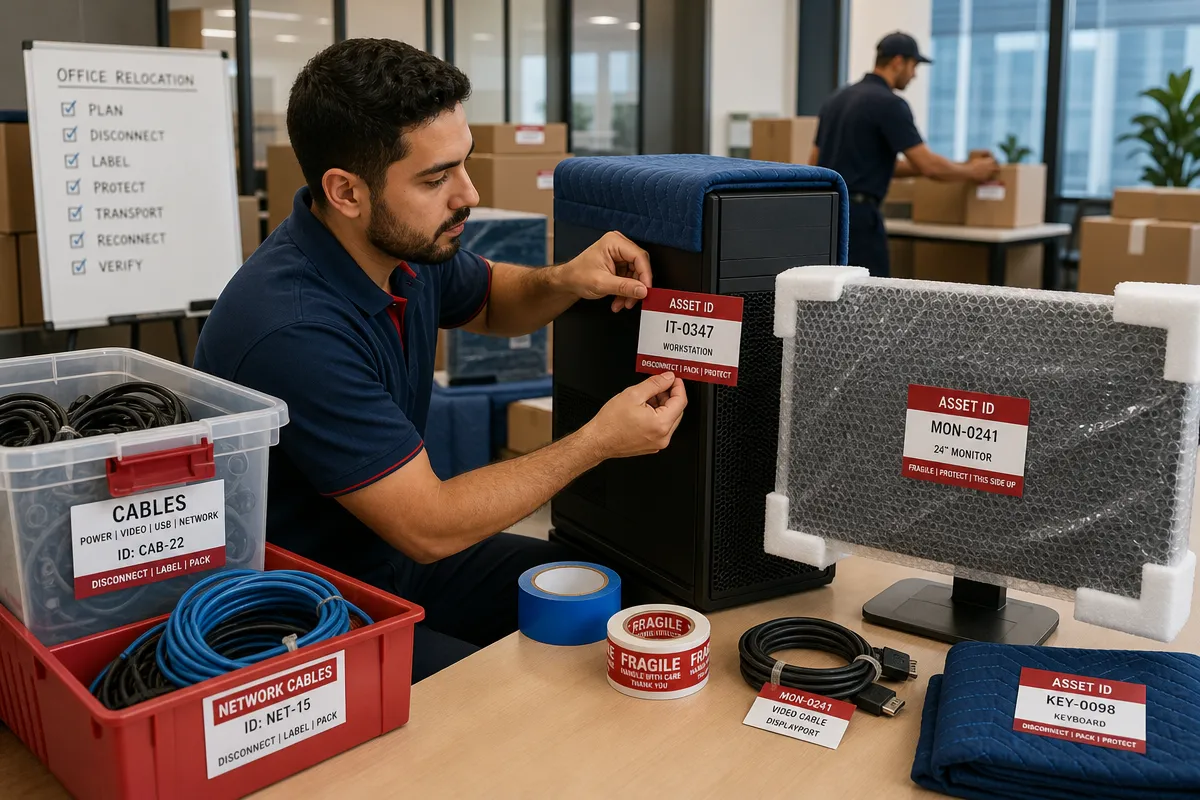
A written scope helps prevent gaps in responsibility
Responsibility should be assigned before the move begins. Packing, labeling, disconnection, dismantling, loading, transportation, storage, unpacking, reassembly, installation, reconnection, testing, debris removal, and cleaning should not be left to assumption. If IT equipment is involved, specify who will disconnect devices, label cables, protect hardware, reconnect workstations, and verify that systems function after delivery.
Technology should receive its own plan. A strong proposal should address protective materials, secure transport, chain of custody, shutdown and restart sequences, expected downtime, testing time, and responsibility for data backups and recovery. High-value or specialized assets may also need declared values, special packaging, climate-controlled storage, chain-of-custody controls, or separate insurance endorsements.
If storage or cross-docking is part of the project, define that scope as well. Storage terms should cover security, access controls, inventory systems, handling procedures, retrieval fees, and delivery standards. Cross-docking means little or no storage between inbound receiving, sorting, and outbound transfer, so timing and destination accuracy matter.
Match the commercial moving company to your geography and complexity
Not every move has the same operational demands. A local single-site office move may depend on building access, crew availability, elevator scheduling, parking, packing volume, and destination setup. Even a nearby relocation can require a site survey because floors, docks, corridors, loading zones, security rules, and move hours can materially change labor and equipment requirements.
Long-distance and multi-location moves introduce additional variables. Interstate projects require transportation planning, registration, route timing, transfer points, shipment tracking, valuation, fuel, tolls, driver hours, and possible storage. Interstate movers must maintain the required registration and authority, and the FMCSA company search can show registration, complaints, safety, and contact information.
Phased and multi-location relocations need stronger coordination
A phased relocation requires sequencing, location-level inventories, branch-specific labeling, temporary storage, consolidation, separate delivery windows, and clear sign-off. Ask whether the provider can supply one accountable project manager, a master schedule, escalation contacts, and reporting that shows what has been received, stored, delivered, installed, and approved.
This is where provider fit matters more than company size alone. Confirm vehicle and crew availability, warehouse capacity, equipment for heavy or delicate items, and the ability to support evening, weekend, or phased work without compromising service quality.
For moves involving warehousing, installation, cross-docking, or multiple locations, RCS can align commercial moving resources with related services such as warehouse storage, cross-docking, and installation.
Building requirements should also be reviewed early. Commercial properties may require certificates of insurance, approved vendor procedures, delivery windows, elevator reservations, loading-dock rules, floor and wall protection, and compliance with building security procedures. A mover that understands these requirements can help reduce last-minute access problems.
Evaluate commercial mover credentials, insurance, pricing, and contract terms
Commercial relocation experience should be documented, not assumed. Ask how many comparable office moves the provider has completed, including projects with similar employee counts, building types, access restrictions, IT environments, modular furniture, records, inventory, or multiple locations.
References are especially useful when they come from businesses with similar requirements. Contact them directly and ask about schedule performance, communication, damage handling, system readiness, and post-move support. Also ask whether the mover provided a dedicated project manager, coordinated with building management and IT personnel, and handled unexpected issues without disrupting operations.
Before signing, verify credentials. For interstate transportation, confirm active U.S. Department of Transportation registration and FMCSA operating authority. The FMCSA moving tips recommend comparing multiple movers and reviewing all included services. For local moves, confirm applicable state or municipal licensing and whether the provider is the actual carrier or a broker using subcontractors.
Insurance and valuation details should be reviewed before move day
Ask for current certificates of insurance covering commercial general liability, automobile liability, workers’ compensation, cargo, and warehouse risks where applicable. Have your insurance adviser review coverage limits, deductibles, exclusions, and whether protection applies during loading, transport, storage, unloading, and installation.
Do not confuse business liability insurance with shipment valuation. FMCSA explains that interstate movers must offer either full-value protection or released-value protection, and released-value protection may limit recovery to 60 cents per pound per item. That difference matters when moving computers, servers, specialized equipment, or other high-value assets.
Pricing also deserves a detailed review. Obtain at least three written estimates based on the same inventory, dates, access conditions, service scope, and insurance assumptions. A useful quote should separate labor, packing materials, transportation, fuel, mileage, travel time, elevators, long carries, dismantling, reassembly, installation, IT handling, storage, unpacking, debris removal, overtime, weekend work, permits, and building fees.
Read the contract for payment milestones, deposit limits, cancellation rights, change-order procedures, delay provisions, claims deadlines, storage terms, liability exclusions, subcontracting, dispute resolution, and responsibility for building damage. Confirm whether the estimate is binding, when it can change, and what documentation authorizes extra work.
Build a move plan that protects downtime and day-one readiness
A successful office relocation is measured by operational readiness, not simply by trucks arriving at the destination. Planning can begin months before moving day, especially when lease notices, construction, property selection, IT infrastructure, or extensive fit-out work are involved. One commercial guide suggests roughly three months for a small office, about six months for a mid-sized office, and six months to a year for larger or technically complex relocations.
Start by appointing an internal project lead and involving the right stakeholders. Facilities, IT, finance, human resources, security, communications, records management, department leaders, building representatives, and the mover all need shared visibility. A single source of truth for inventories, floor plans, schedules, labels, contacts, and approvals helps prevent competing versions of the plan.
Before move day, confirm the items that most often affect schedule and access. These details should be reviewed early enough to correct problems before crews arrive. The goal is to avoid downtime caused by missing approvals, incomplete destination preparation, or unclear employee instructions.
Lease obligations and building rules at both locations
Elevator, dock, loading zone, and parking reservations
Certificates of insurance required by each property
Destination floor plans, room labels, and furniture layouts
Employee packing, labeling, and return-to-work instructions
Data backups, cabling, internet service, server-room readiness, and IT cutover timing
Disposal, recycling, storage, cleaning, and debris removal arrangements
Destination setup should be verified area by area
Unloading is only one part of destination readiness. The plan should include placement by room or workstation, modular furniture reassembly, workstation installation, monitor and peripheral placement, cable management, signage, removal of packing debris, and protection for floors and surfaces.
Use phased sign-off instead of waiting until the end of the full project. Department representatives can verify furniture, records, inventory, and room assignments as areas are completed. IT can test phones, internet, VPN access, servers, printers, conferencing systems, and other business-critical tools before employees arrive.
Maintain an exception log for missing, damaged, mislabeled, or uninstalled items. The contract should state who records condition, photographs damage, files claims, authorizes corrective work, and pays for re-delivery or replacement when the mover is responsible. Post-move support can also reduce disruption through workstation adjustments, surplus removal, crate collection, additional deliveries, storage retrievals, installation corrections, and unresolved claims support.
If your company is planning a commercial relocation in Virginia or North Carolina, RCS Commercial Moving & Warehousing can help you evaluate the scope, schedule, storage needs, installation requirements, and logistics plan. Get a Quote through our contact page, email us at contact@rcsmoving.com, or call us today at (804) 358-4035.