


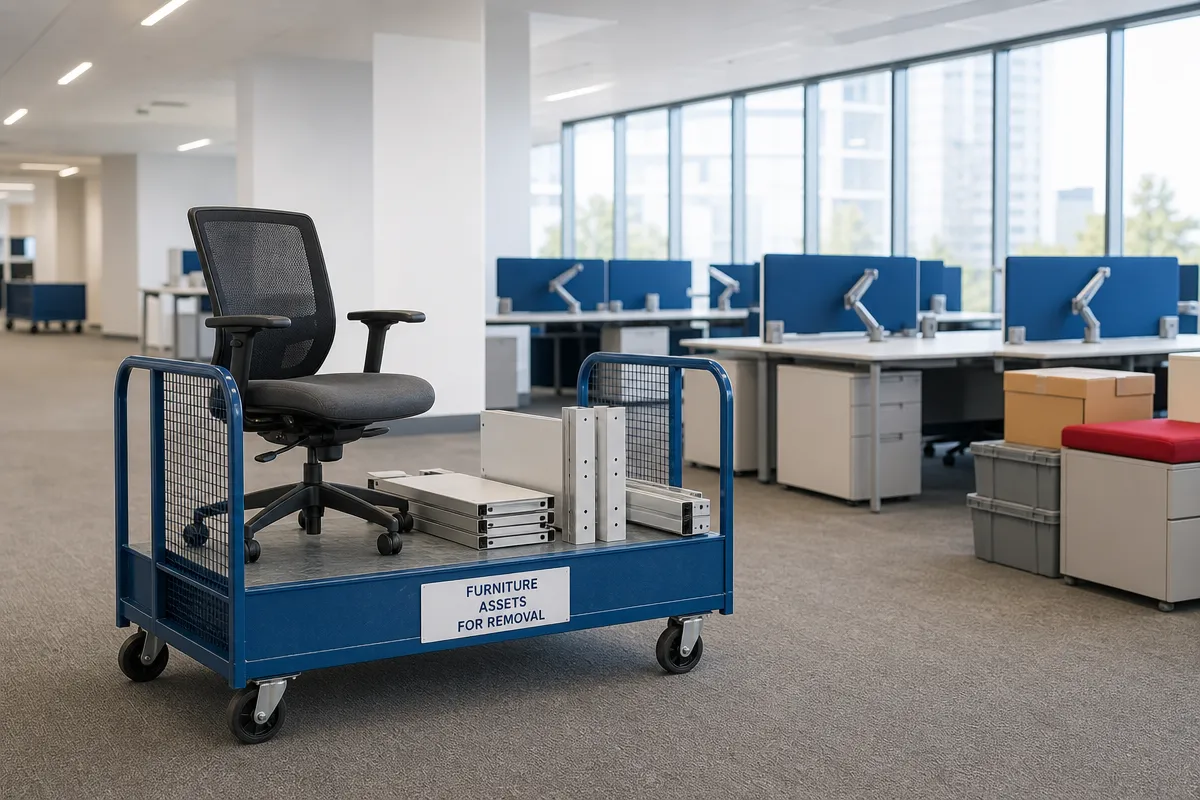
Office furniture decommissioning is the planned process of removing, redirecting, documenting, and closing out furniture and related assets before an office is handed back, renovated, or reoccupied. It is not just a hauling task. It touches lease obligations, building access, IT security, inventory control, storage, resale, recycling, cleaning, and final landlord acceptance.
At RCS Commercial Moving & Warehousing, we help companies across Virginia and North Carolina plan commercial moves, storage, logistics, installation, and related closeout work with the discipline these projects require. If you have questions as you begin planning, reach out to our team through our Contact Us Today page.
Start office furniture decommissioning with the surrender date and lease requirements
The surrender date should drive the entire project schedule. A lease end, renovation phase, or office closure often creates a fixed deadline, and every task needs to work backward from that date. The goal is to leave the premises in the condition required by the lease, landlord, or property manager.
Office decommissioning includes removing or redirecting furniture, equipment, cabling, fixtures, signage, and debris while meeting handback expectations. The lease may contain requirements for surrender condition, restoration, “broom-clean” standards, holdover penalties, access rules, signage removal, cleaning, and tenant improvements. Written clarification from the landlord or property manager helps prevent late disputes.
Assign one project owner early. That person should have authority to coordinate facilities, IT, finance, procurement, HR, security, vendors, and building management. Without a clear owner, furniture decisions, access paperwork, IT removal, and cleaning can move on different timelines.
A practical planning rhythm typically looks like this:
120 to 90 days before surrender: Review the lease, complete a landlord or property-manager walkthrough, document existing conditions, and begin the furniture and equipment inventory.
90 to 60 days before surrender: Obtain proposals for removal, storage, liquidation, recycling, IT work, restoration, and cleaning, then approve the disposition plan.
60 to 30 days before surrender: Finalize vendors, submit insurance documents, reserve elevators and docks, and start removing items from unused areas.
30 to 14 days before surrender: Complete IT collection, furniture removal, cabling work, repairs, and waste pickups.
Final week: Clean, inspect, complete the punch list, photograph the suite, return access credentials, and obtain written handback acknowledgment.
The closer the project gets to the surrender date, the less flexibility remains. Early lease review and landlord communication reduce the risk of rushed labor, missed restoration work, or unplanned holdover issues.
A detailed asset inventory controls furniture decisions and project costs
A reliable inventory is the foundation for every decommissioning decision. It shows what exists, where it is located, who owns it, what condition it is in, and what should happen to it. Without that baseline, crews can remove the wrong items, miss storage areas, or discover late that furniture does not fit the next workplace.
The inventory should cover every office, conference room, storage room, kitchen, server room, reception area, and off-site storage cage. Record asset type, manufacturer, model, quantity, dimensions, condition, location, department, owner, asset tag or serial number, photographs, and special handling requirements.
Be especially careful to separate tenant-owned property from landlord-owned assets. Removing something that belongs to the building can create repair or replacement obligations. This is one reason the inventory should be tied to the lease review and landlord walkthrough, not handled as a separate administrative exercise.
Every item should receive an approved destination before removal begins. Sorting furniture on the loading dock increases labor, handling, and schedule risk. A shared disposition register gives the field team clear instructions and gives the project team a record for closeout.
Relocate: Furniture that fits the new floor plan and remains useful.
Store: Assets needed for a later project phase, future expansion, or delayed decision.
Reuse or reconfigure: Modular systems, seating, storage, or conference furniture that can serve another department or location.
Resell or liquidate: Newer, complete, standardized, and marketable assets.
Donate: Usable items with a confirmed recipient and scheduled pickup.
Recycle: Furniture and materials without practical resale or donation value.
Dispose: Residual material that cannot be recovered through higher-value options.
Inventory quality affects budget accuracy. It supports liquidation valuations, identifies disassembly needs, separates specialized handling, and helps reconcile assets at the end of the project.
Disposition, storage, IT, and building logistics should be sequenced before removal
Furniture disposition works best when every stream is planned before trucks arrive. Relocation, resale, donation, recycling, disposal, storage, and installation each have different handling requirements. If decisions are postponed until move day, labor becomes reactive and the schedule becomes harder to control.
For liquidation, request a written offer that separates buyback credit, removal labor, transportation, recycling, and disposal charges. A large furniture volume does not automatically produce a net payment. Older casegoods, incomplete systems furniture, or assets with limited market demand may cost more to remove and process than they return in resale value.
Storage should be treated as an active project service, not a place to send undecided items. Warehouse teams can receive, inspect, tag, photograph, stage, and release assets by department, destination, or installation phase. For phased relocations or renovations, cross-docking can move incoming furniture directly to outbound trucks or short-term staging when timing is tight.
This is where RCS often fits naturally into the project plan, because commercial moving, warehouse storage, cross-docking, installation, and logistics must work together when furniture is being relocated, held, reconfigured, or released in phases.
IT assets need their own sequence. Devices should be identified by asset tag or serial number, tracked through chain of custody, and sanitized or destroyed through an approved process when needed. The EPA electronics donation and recycling guidance emphasizes deleting or sanitizing information before donation or recycling and handling batteries separately from ordinary waste.
Building rules can change the labor plan
Origin and destination building requirements should be confirmed in writing. Typical requirements include a certificate of insurance, correct property entities, additional-insured wording, freight-elevator reservations, loading-dock appointments, truck-size limits, parking or street permits, crew lists, floor and wall protection, security check-in, deposits, and permitted move hours.
After-hours or weekend work may be required in occupied buildings. Elevator delays, dock congestion, weather, traffic, and incomplete paperwork can all affect the schedule, so contingency time should be built into the plan. Furniture that will be installed elsewhere should also be mapped to the receiving floor plan before disassembly begins.
Recovery, restoration, and documentation prepare the office for turnover
A recovery-first plan prioritizes reuse before recycling and disposal. The non-hazardous materials waste hierarchy ranks source reduction and reuse ahead of recycling, energy recovery, and disposal. For office furniture, that means internal redeployment, reconfiguration, refurbishment, resale, and donation should be considered before landfill disposal.
Separate material streams before removal begins. Reusable furniture, resale inventory, confirmed donations, metal, clean wood, cardboard, plastics, electronics, batteries, confidential records, and residual waste should not all be treated the same way. EPA guidance also identifies refurbished furniture and recovered materials as practical opportunities within non-paper office products.
Donation requires more than good intent. A recipient must accept the items, and transportation must be scheduled. Recycling and disposal should also be documented with appropriate records. Useful closeout materials include resale statements, donation receipts, recycling weight tickets, disposal receipts, e-waste certificates, data-destruction certificates, warehouse receiving records, and a diversion summary by material or disposition path.
Restoration should happen after removal exposes the true condition of the premises. Depending on the lease, the scope may include pulling tenant-installed data cabling, removing signage, taking down wall-mounted equipment, removing shelving or partitions, patching anchor holes, repairing damaged floors or ceiling tiles, repainting, and restoring tenant improvements.
Final cleaning should be scheduled after furniture, cabling, fixtures, repairs, and debris are gone. “Broom clean” commonly means an empty suite with floors swept or vacuumed and no remaining furniture, equipment, trash, or debris, but the lease may call for more work.
Costs vary widely because access, restoration, furniture condition, schedule compression, storage, IT work, and construction coordination all matter. Published examples include $150 to $300 per workstation for removal labor in one commercial source, while another gives broad office decommissioning ranges from $3,000 to $150,000 or more depending on office size. These are planning references, not universal prices.
Before the landlord walkthrough, inspect every room, closet, storage area, kitchen, server room, ceiling, floor, and wall against the agreed scope. Confirm that furniture, equipment, files, cabling, signage, trash, and debris are gone. Photograph the finished condition, return keys and badges, reconcile the inventory, and obtain written landlord acceptance when available.
If your company is planning an office furniture decommissioning project in Richmond, Charlotte, Raleigh, Virginia Beach, Washington, DC, Roanoke, or nearby service areas, RCS can help coordinate the move, storage, logistics, installation, and closeout details. Request a Quote or call us today at (804) 358-4035.