


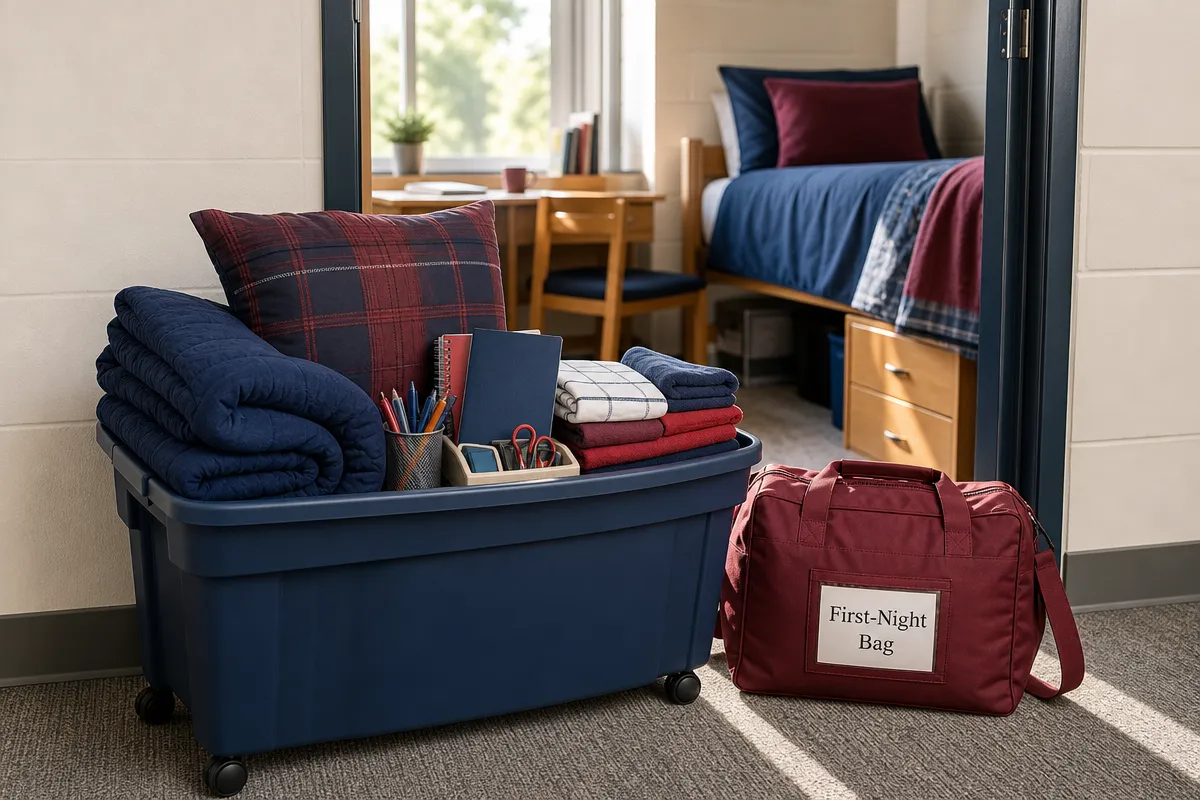
A practical dorm move-in checklist starts with the room you are actually moving into, not with a shopping cart full of “college essentials.” Before buying bins, bedding, appliances, or decorations, confirm the residence hall rules, bed size, room dimensions, storage options, roommate arrangement, and move-in instructions.
At RCS Commercial Moving & Warehousing, we help organizations plan moves across Virginia and North Carolina, and the same moving principle applies here: the best relocation starts with clear rules, careful labeling, and less clutter.
If you have questions about planning a move or storage project, reach out to our team through our contact page.
Start Your Dorm Move-In Checklist With Room Rules and Roommate Coordination
The first step is to confirm what the dorm room can actually hold. Many colleges use Twin XL mattresses, often approximately 36 by 80 inches, but students should verify the bed size with housing before purchasing sheets, mattress pads, or protectors. The room layout, closet space, bed height, and furniture policy should guide every packing decision.
Roommate coordination matters just as much. Shared items can quickly become duplicates if everyone shops separately. Before move-in day, talk through who is bringing larger or shared items such as a mini-fridge, television, vacuum, coffee maker, cleaning supplies, kitchenware, or a microwave combination unit if the school allows one.
Packing should also reflect the realities of residence halls. Some buildings do not have elevators, and students may need to carry everything through crowded halls or stairwells. Rutgers recommends moderately sized boxes for move-in, and other universities advise labeling every container with the student’s name, residence hall, and room number.
Pack containers that are easy to carry and useful after move-in
Medium boxes, suitcases, and reusable bins are often more practical than oversized cartons. Use towels and bedding as padding where possible instead of packing extra materials that will need to be discarded. Reusable bins can become under-bed or closet storage after everything is unpacked.
Keep a clearly marked first-night bag accessible in the vehicle or at the top of the stack. It should include medication, toiletries, pajamas, a change of clothes, bedding, chargers, important documents, and a water bottle. If unpacking takes hours, the student can still sleep, shower, charge devices, and function the next morning.
Pack Bedding, Bath, Laundry, and Cleaning Supplies Without Overloading the Room
Bedding is one of the few categories to handle before arrival, as long as the bed size is confirmed. A useful set includes Twin XL fitted sheets if required, at least one spare sheet set, pillowcases, pillows, a mattress pad or protector, and a comforter or blanket. ACT recommends bringing Twin XL fitted sheets when that is the dorm mattress size.
Bath supplies depend on whether the student has a communal or private bathroom. For communal bathrooms, a shower caddy keeps toiletries together and makes trips down the hall easier. A practical bath kit includes towels, washcloths, shower shoes or flip-flops, shampoo, conditioner, soap or body wash, toothbrush, toothpaste, deodorant, a hairbrush, razor, and daily personal-care items.
Laundry is another category where too much gear becomes clutter. Bring a hamper or washable laundry bag, detergent suitable for the machines, stain remover, dryer sheets if desired, hangers, a lint roller, and a small sewing kit with safety pins. Students should also check whether laundry uses a campus card or coins.
Cleaning supplies should be compact. Dorm rooms usually do not need a full household setup on day one. Confirm whether the residence hall provides vacuums, brooms, dustpans, toilet brushes, or drying racks before transporting bulky items.
Disinfecting wipes for desks, handles, and frequently touched surfaces
Paper towels or reusable cloths for quick cleanups
Dish soap and a sponge for cups, bowls, and containers
Trash bags sized for the dorm room bin
An all-purpose cleaner appropriate for approved room surfaces
Choose School Supplies, Technology, Clothing, and Health Items That Fit Daily Life
The academic setup should support classes first. A laptop or tablet, charging cable, protective case, headphones, phone charger, backpack, notebooks, pens, pencils, highlighters, folders or binders, and a planner or digital calendar cover the core needs. Depending on coursework, a desk lamp, calculator, USB adapter, flash drive, or mouse may be useful.
Power rules deserve special attention. Students should not assume standard extension cords, cube taps, or multi-plug adapters are allowed. Several universities prohibit extension cords and permit only surge-protected power strips with circuit protection plugged directly into the wall. Housing policies should be checked before packing any electrical item.
Technology should be limited at first. A printer is often optional because campuses commonly provide printing. Large monitors, televisions, gaming systems, speakers, desktop computers, and extra lamps can consume limited desk and floor space. Bring the equipment needed for coursework and communication first, then add entertainment items later if the room has space.
Clothing should be practical and seasonal. Pack everyday class clothes, sleepwear, underwear and socks, workout clothing, comfortable shoes, one dress or business-casual outfit, a rain jacket or umbrella, and weather-appropriate outerwear. Central Michigan University recommends planning for changing weather rather than packing only one season.
Health and personal-care items are essential, but they should still be organized. Prescription medications should stay in their original containers, with enough supply for the transition period. Iona University recommends students consider transferring prescriptions to a local pharmacy and requesting refills before running out.
A compact first-aid kit belongs near daily essentials
A small first-aid kit can include adhesive bandages, gauze, medical tape, antibiotic ointment, hydrocortisone cream, a thermometer, antihistamine, acetaminophen or ibuprofen, cough drops, electrolyte packets, and insect repellent. Students should also know how to contact campus health services before they need help.
Use Space-Saving Storage and Leave Restricted Dorm Items at Home
Dorm storage should be based on actual measurements, not guesswork. Useful options include lidded under-bed bins, soft storage bags, stackable drawers, slim hangers, a hanging closet organizer, over-the-door shoe storage, small baskets, and a bedside caddy. Under-bed space is often the largest unused storage area, especially for spare bedding, laundry supplies, shoes, school materials, and out-of-season clothing.
This is where moving discipline makes a real difference. In our commercial moving work, we see how labeling, grouping, and right-sizing containers prevent delays, and the same habits help students avoid digging through mixed boxes in a small dorm room.
Vertical storage can help, but it must follow housing rules. Some colleges restrict nails, tapes, adhesive products, door-mounted equipment, or items placed near sprinklers and exits. Storage should never block walking paths, radiators, vents, doors, smoke detectors, or safety equipment.
Kitchen items and appliances require careful checking. A student with a dining plan may only need a reusable water bottle, travel mug, bowl, plate, cup, utensils, food-storage containers, napkins, dish soap, and sponges. Students using shared kitchens may need cookware, a can opener, utensils, and a labeled dish towel.
Do not buy appliances until the school policy is clear. Tufts limits rooms to one mini-fridge or approved MicroChill unit, while other schools set different limits for microwaves, refrigerators, coffee makers, kettles, and cooking devices.
Some items are commonly prohibited because of fire, electrical, or safety risks. Check the official residence-life page before packing anything questionable. When in doubt, leave it at home and buy locally later only if it is allowed and truly needed.
Candles, incense, wax warmers, fireworks, grills, gas burners, and flammable materials
Hot plates, toaster ovens, air fryers, deep fryers, pressure cookers, rice cookers, and electric griddles
Space heaters, air conditioners, halogen lamps, lava lamps, and nonapproved string lights
Unauthorized extension cords, cube adapters, overloaded power strips, and daisy-chained power strips
Bulky furniture, duplicate appliances, excessive decorations, and heavy exercise equipment
The final check is simple: compare every item against the university’s housing page, roommate plan, room dimensions, and move-in instructions. Label every container, keep medications and documents accessible, and avoid filling the room before the student understands the space.
If your organization is planning a larger relocation, storage project, installation, or logistics move, RCS Commercial Moving & Warehousing can help you plan it with the same level of organization. Get a Quote through our contact page, Call us today at (804) 358-4035, or Email us at contact@rcsmoving.com.